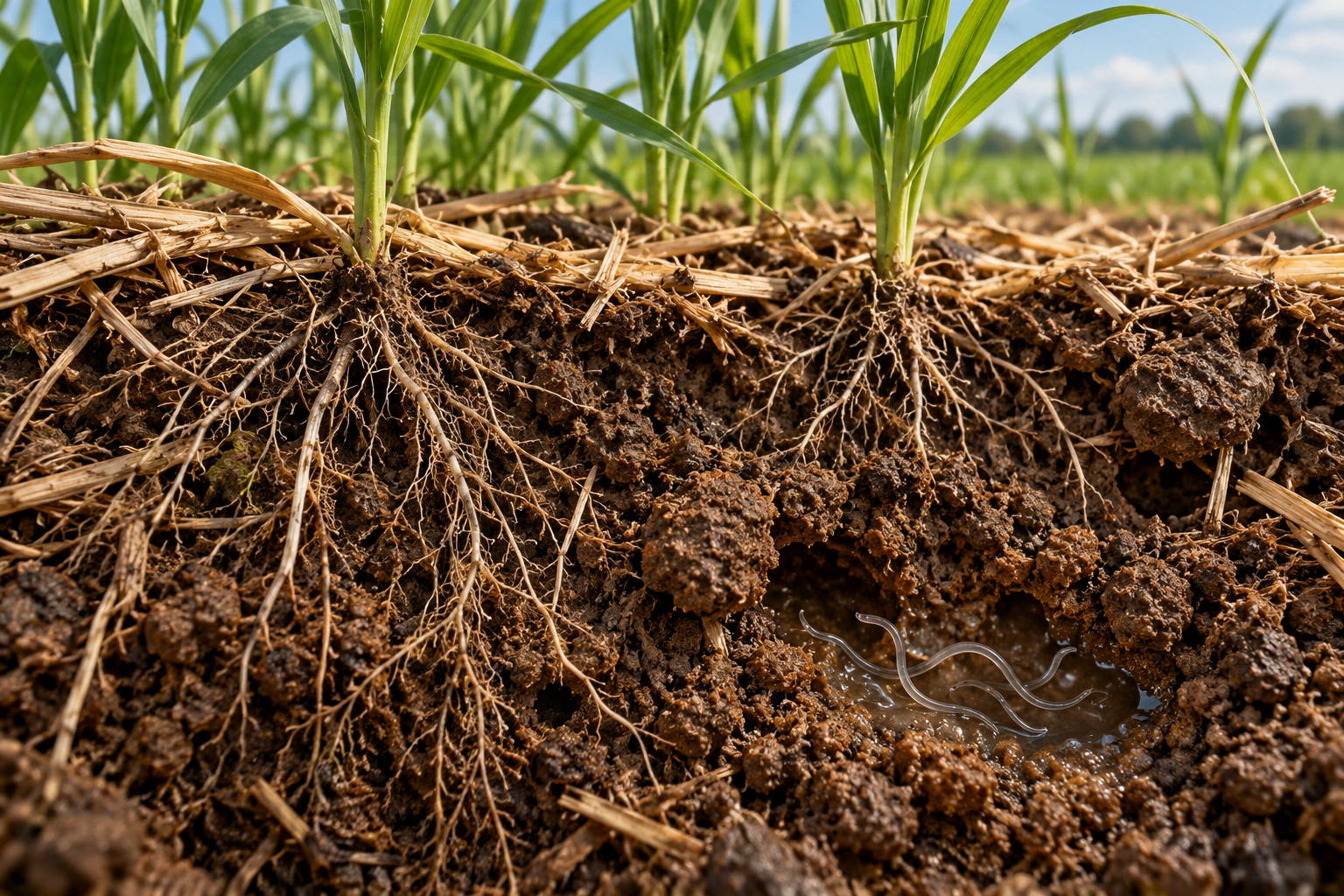
Cultivating soil also changes a habitat
After cultivation, we first notice the surface: loosened earth, incorporated plant residues or a prepared seedbed. Beneath that visible change are organisms for which each intervention creates different conditions. Nematodes, tiny roundworms, are among them. Some feed on plants, others on bacteria or fungi; others are predators or use different food sources. Treating them all as pests overlooks much of their ecological significance and the different roles they perform below ground.
Those feeding habits make their communities particularly informative. They offer clues about how resources are used and which life strategies occur under a particular management system. A study published in 2019 by Giulia Bongiorno and colleagues investigates these relationships across European long-term experiments. For RED, it raises a practical question: how do we change the habitat beneath our feet while trying to make the soil more suitable for plants?
Ten long-term experiments, without a universal prescription
The investigation brings together ten field experiments with different soils, climates and cropping systems. It compared conventional and reduced tillage, alongside lower and higher organic matter inputs. Not every experiment contained every combination. The findings therefore come from a combined analysis that accounts for the individual experimental designs. We should not imagine ten identical fields receiving the same machinery, crop and material applications everywhere.
This design is both a strength and a limit. Patterns that recur across different conditions are especially interesting for practice. Yet site differences do not disappear when an overall average is calculated. Reduced tillage also covers different approaches, including shallow or non-inversion cultivation. The study therefore does not establish that abandoning tillage completely would be best on every field. It examines how different management intensities affect selected biological characteristics, leaving the actual choice of operations connected to local conditions.
From DNA evidence to an interpretation of the food web
The team characterised nematode communities using molecular methods. DNA sequencing helped identify different groups, while quantitative PCR contributed information about their abundance. The researchers then calculated diversity measures and functional indices. These indices organise the detected organisms according to characteristics such as feeding habits and life strategies. They condense many observations into comparable measures without making every process in the soil directly visible.
That distinction matters. Detecting an organism does not automatically reveal its current activity or the amount of food it processes. A nematode community is also an informative part of soil life, rather than a complete inventory of every organism. The study relates that biological perspective to other soil characteristics. This provides a more useful starting point for interpretation than simply asking whether a sample contains many or few roundworms, without considering which groups are present.
Greater diversity and changes in functional indices
Reduced tillage was associated with a more diverse nematode community in the analysis. The diversity measure derived from the Shannon index was approximately 23 per cent higher. The Maturity Index, which describes community composition through life strategies, increased by about 12 per cent. The Structure Index was around 24 per cent higher. Together, these results indicate communities whose composition is consistent with less disturbance and a more developed food-web structure.
The Channel Index was approximately 59 per cent higher. It uses particular feeding groups to indicate the relative importance of fungal and bacterial decomposition pathways. This means neither 59 per cent more fungal biomass nor an equivalent increase in measured decomposition. The other percentages likewise describe relative differences in their respective indices, rather than percentage points or guaranteed improvements in every soil function. Understanding the findings requires keeping these different measurements separate.
The trade-off belongs at the centre of the findings
A favourable-looking change in several indices did not mean that every nematode group was equally desirable from a crop-management perspective. Under reduced tillage, the estimated absolute abundance of herbivorous nematodes was also around 70 per cent higher. This result cannot be omitted when drawing practical lessons. A more diverse food web and a greater abundance of plant feeders can occur together within the same management comparison.
More plant feeders do not, however, demonstrate proportionately greater yield losses. That would require information about the nematodes involved, the crop, its susceptibility and actual damage. Nor does the study establish that other food-web members reliably compensate for the increase. RED therefore needs to maintain two lines of attention: support biological development and carefully observe plant performance. A favourable index cannot replace examination of roots and the crop stand, especially where a particular problem is suspected.
Organic inputs still matter
In this investigation, tillage had a stronger overall influence on nematode communities than differences in organic inputs. This does not justify concluding that compost, plant residues or other organic materials are generally ineffective. Inputs differed among experiments in both type and amount. A common analytical category can therefore combine conditions that are far from identical for the organisms concerned, even when they share the same broad management label.
Organic materials, site conditions and cultivation also interact. Where material remains within the soil profile and the conditions found there matter alongside its quantity. The study identified relationships between communities, carbon and microbial characteristics. These associations help interpretation, but do not establish a single causal pathway on their own. The useful practical lesson is to plan material supply and physical interventions together, rather than expecting one question to make the other unnecessary.
What stability means here, and what remains unresolved
Maturity, structure and stability are interpreted here through biological indices. The work is not a direct stress test demonstrating better recovery after drought, machinery traffic or disease on every field. Greater diversity also provides no automatic answer about yield, weed pressure or the suitability of a particular implement. Those questions require their own observations and must be considered alongside the biological findings before a management decision can be judged successful.
The spatial perspective matters too. Soil layers can respond differently to management; a favourable signal near the surface does not describe the entire rooted profile. When transferring findings to another climate or crop, the starting conditions should therefore be compared first. The investigation gives a reasoned basis for questioning unnecessary disturbance. It does not remove the responsibility to decide what is appropriate for a specific site.
The RED question: what is each intervention meant to achieve?
For RED, the study suggests a clear approach: identify the actual problem before cultivating. Is the aim to address demonstrated compaction, establish plants or perform another task? Appropriate depth, intensity and timing follow from that purpose. A recurring operation does not become necessary simply because it belongs to an established routine. Its intended benefit should remain clear enough to be assessed afterwards.
This approach is RED's interpretation of the evidence. It is neither a blanket prohibition on cultivation nor a promise that fewer passes will immediately solve every soil problem. A documented comparison is more useful: establish the starting conditions, define the intervention and subsequently examine both soil and plants. Nematodes can provide an additional biological perspective. The central question remains whether the chosen management supports the intended development under the conditions of the particular project.
Scientific source
Giulia Bongiorno; Natacha Bodenhausen; Else K. Bünemann; Lijbert Brussaard; Stefan Geisen; Paul Mäder; Casper W. Quist; Jean-Claude Walser; Ron G. M. de Goede (2019): Reduced tillage, but not organic matter input, increased nematode diversity and food web stability in European long-term field experiments. Molecular Ecology 28(22), 4987–5005.
DOI: 10.1111/mec.15270
Open the freely accessible original publication
Published correction: Corrigendum (2021). DOI: 10.1111/mec.15741
Editorial interpretation: This article explains a scientific publication. The RED practice sections identify ideas drawn from the findings; they are not results of an experiment conducted by RED.