What the abbreviation BEAM means
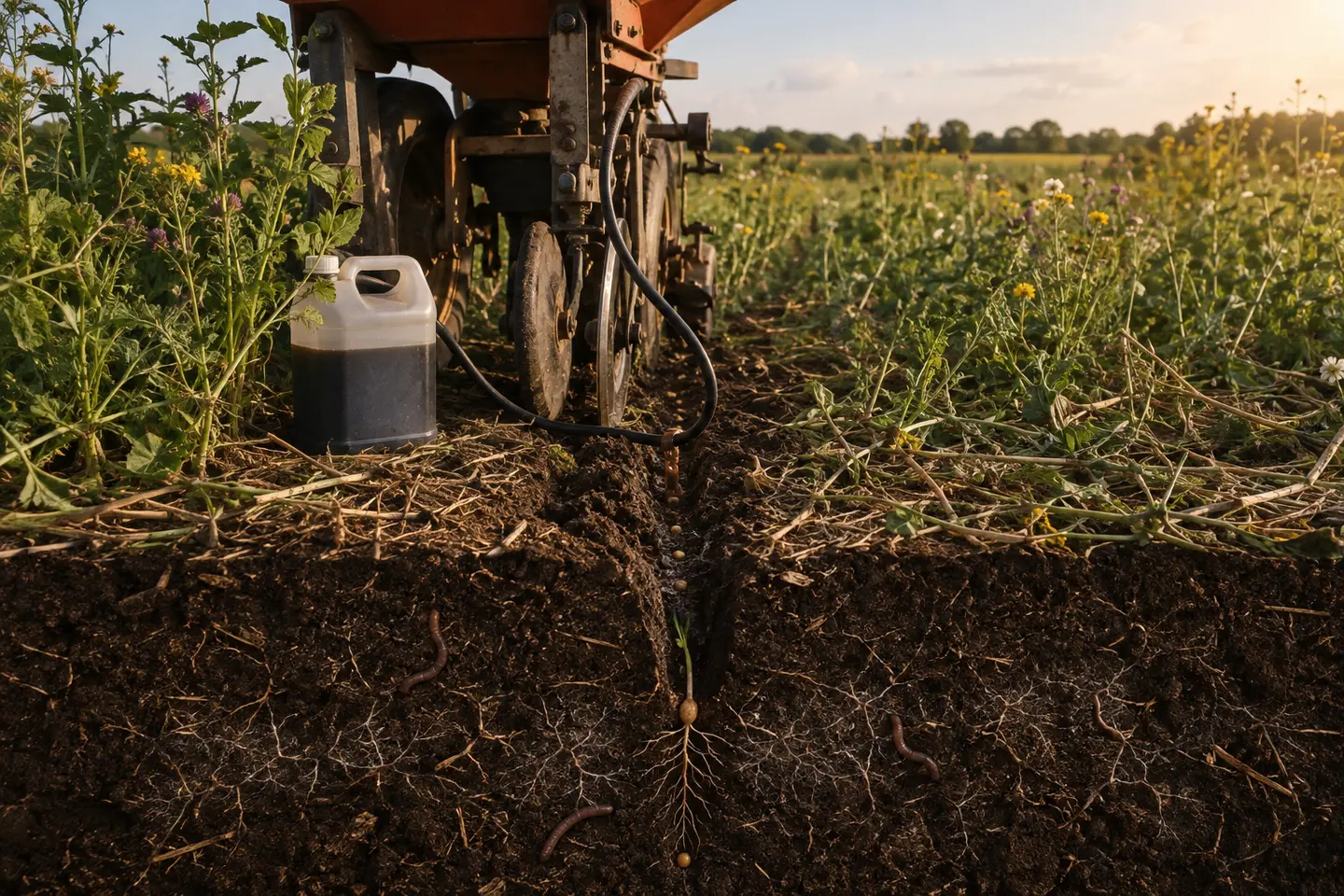
BEAM stands for ‘Biologically Enhanced Agricultural Management’. It is not a single product, but a management package designed to reduce soil disturbance, increase living roots and plant diversity, and deliberately support microbial communities. On the studied commercial field near Söke in western Turkey, no-till, diverse cover crops, greatly reduced synthetic inputs and an extract from long-matured, fungi-dominated vermicompost were combined.
The study is interesting because it operated in the field for several years rather than only in a greenhouse. Yet that package also complicates interpretation: when soil and yield change, the respective contributions of no-till, cover crops, reduced nitrogen, compost extract or their interaction cannot be clearly separated.
The trial ran on a 5.22-hectare field previously conventionally cropped with cotton and sunflower. According to the publication, the fluvi-calcaric soil consisted mainly of sand and silt. The Mediterranean climate, with warm summers and a need for irrigation, differs markedly from many Central European sites.
No-till, cover crops and a very small amount of compost material
The cover-crop mixtures contained several species, especially legumes. They were not terminated chemically, but rolled at roughly half bloom or early grain formation. Plant material remained as soil cover, while roots and the rhizosphere had supplied carbon to the soil for many months beforehand.
The vermicompost matured for at least one year in a static Johnson–Su bioreactor at high but aerobic moisture. Earthworms were introduced after cooling. Only a very small amount was applied to the field as a water extract in the seed furrow: the publication reports about 187 litres of extract per hectare containing approximately 2.2 kilograms of vermicompost per hectare.
Three nitrogen levels under the same system
The field was divided into three nitrogen treatments. One received the usual full farm rate of 203 kilograms of nitrogen per hectare, a second only 15 per cent – about 30.5 kilograms – and a third received no mineral nitrogen. All three were otherwise managed under the BEAM package.
This division reveals how plant production within the system responded to different nitrogen rates. It does not provide a direct ‘BEAM versus conventional’ comparison because there was no spatially replicated conventional control. Instead, the study follows the development of one converted field over four years.
Soil organic carbon was examined in 2019, 2020, 2022 and 2023 at three depths: 0–15, 15–30 and 30–45 centimetres. At six locations, multiple cores were combined into composite samples, carbonates were removed and organic carbon was determined by dry combustion.
The striking carbon values
In the upper layer, measured organic carbon rose from 0.39 per cent in 2019 to 1.83 per cent in 2023 – an increase of 1.44 percentage points that was statistically significant. At 15–30 centimetres it fell by 0.23 percentage points without a statistically clear trend. At 30–45 centimetres it rose by 0.28 percentage points, a significant trend.
From the measurements and assumed bulk densities, the authors calculated a mean annual increase of about 6.59 tonnes of carbon per hectare in the upper 45 centimetres. This is very high for arable soil and should be understood as a result of this field and calculation, not as a universal BEAM factor.
Total soil nitrogen increased in parallel. The authors report a close statistical relationship between carbon and nitrogen, with an R² of 0.99 and a carbon-to-nitrogen ratio around 11.5. This is consistent with organic-matter formation, which requires not only carbon but nitrogen and other nutrients.
More cover-crop biomass and fewer external inputs
Measured cover-crop biomass rose over the project from roughly 400 to 692 and finally about 925 grams of dry matter per square metre. More plant production means more potential carbon input from roots, exudates and residues. Farm observations also described earthworm density rising from virtually zero to about 100 animals per square metre, although this figure did not come from the same rigorous design as the laboratory values.
According to the study, herbicide use ceased completely, insecticide use fell by 56 per cent, diesel use by about 61 to 65 per cent depending on the calculation, and mineral nitrogen in the 15-per-cent treatment by 85 per cent. Phosphorus fertiliser was no longer used. Reduced irrigation was also described, but is likewise site- and year-specific.
In the economic analysis, the treatment receiving 15 per cent of the usual nitrogen rate performed especially well on average. It combined yield with markedly lower costs. This is practically important: a system will be retained only if ecological improvement and commercial viability work together.
Why the results are not yet a general guarantee of effectiveness
The trial covers one field without a randomised, replicated conventional control. Weather, irrigation, crop sequence and temporal trends may have influenced the results. Because all regenerative measures were introduced together, it remains unclear whether the microbial extract was necessary or no-till and productive cover crops contributed most.
Sampling took place in only four of five calendar years; carbon data for 2021 are missing. With high calculated accumulation rates, independent replication on other soils and transparent accounting for bulk density, initial variability and equivalent soil mass are essential. A complete greenhouse-gas balance would also include nitrous oxide, energy, irrigation and possible displacement effects.
The study therefore provides a strong signal that plant- and soil-biological management can accompany substantial change. It does not yet prove that every BEAM system achieves the same rate or that compost extract alone is responsible.
Why this matters for RED
BEAM touches several core ideas of the RED Method: continuous photosynthesis, low disturbance, diverse roots, return of organic matter and deliberate support for functional soil life. The link between ecological and economic metrics is particularly valuable. Regeneration must be visible not only in the laboratory, but viable as a practical farming pathway.
For RED, this is not a finished recipe but a mandate for experimentation. Where possible, individual components should be tested separately and against reference treatments. A cover-crop and no-till treatment without extract, for example, would be important for identifying the added contribution of inoculation. Carbon stocks, nitrogen dynamics, yield, water demand, inputs and biodiversity should be documented together.
Open the freely accessible original publication