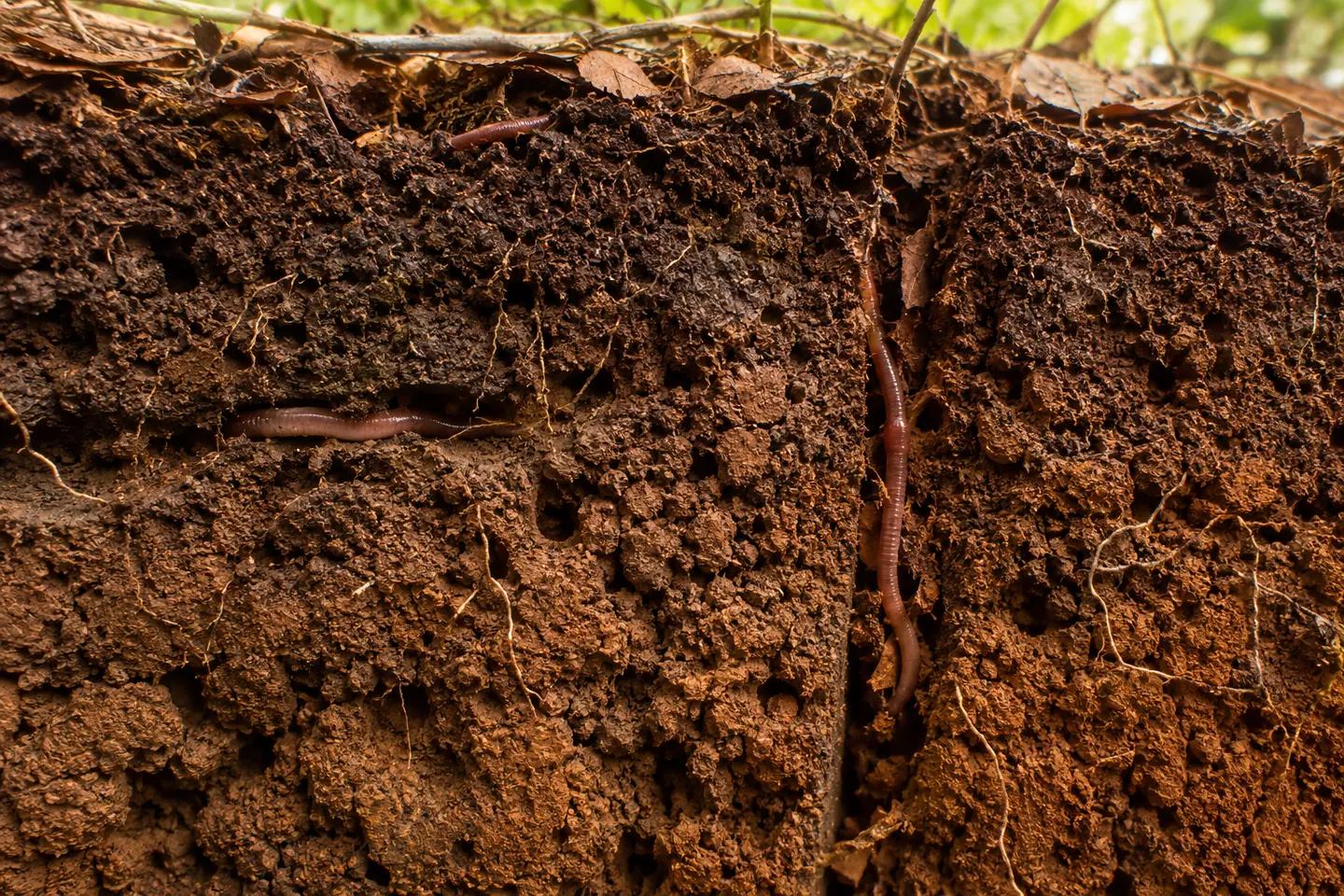
Why earthworms are considered ecosystem engineers
Earthworms alter their habitat physically and biologically. They dig burrows, pull litter into the soil, break down organic matter and excrete structurally rich aggregates. Around their burrows – in the so-called drilosphere – zones develop with different pores, nutrients and microbial activities from the surrounding soil.
The review by Wu and colleagues combines two topics: earthworm breeding methods and the animals’ role in microbial regulation and carbon. It is a conceptual overview, not a single field experiment. The effects described come from different species, soils and experiments and must not be interpreted as one uniform effect.
Earthworms are particularly tangible representatives of a broader principle: soil structure is shaped not only by minerals and machinery. Living organisms build and maintain pore systems, hotspots and transport routes.
Three ecological groups with different roles
Epigeic species live mainly in surface litter. They process fresh organic matter and are often used in vermicomposting. Endogeic species live in mineral soil and predominantly build horizontal burrow systems. They ingest large amounts of soil and mix organic matter into aggregates.
Anecic species create deep, relatively permanent vertical burrows and pull surface litter downwards. These macropores can carry water, air and roots into deeper layers. The three groups are not interchangeable ‘worm types’; species also differ in their climatic needs, food and reproduction.
Pores, infiltration and root pathways
As they burrow, earthworms displace and ingest soil. Open macropores often improve aeration and rapid infiltration. Plant roots use older burrows as pathways of low mechanical resistance, enabling them to reach deeper water and nutrient reserves.
The effect depends on burrow stability, soil type and connection to the surface. Vertical burrows can be particularly valuable in compacted soils. However, they can also create preferential flow paths that carry dissolved nutrients or pesticides into deeper layers. More macropores are therefore not automatically beneficial in every respect.
Earthworm casts are often denser yet aggregated. Mucus, fragmented organic particles, clay and microbial products are mixed together. Drying and ageing processes can turn them into stable structures.
Gut, casts and drilosphere as microbial hotspots
During passage through the gut, organic materials are fragmented, moistened and mixed with mucus and microorganisms. Oxygen, pH and nutrient availability change temporarily. Some microbes are digested, while others survive passage or multiply in fresh casts.
Earthworms are therefore not simply ‘multipliers of beneficial microbes’. They filter, transport and alter communities. In the drilosphere, roots, mucus and incorporated litter sustain high activity. Over time, fresh hotspots may subside again or develop into more stable aggregates.
This spatial heterogeneity is functional. Soil does not need to be equally active everywhere. Local hotspots can combine rapid nutrient release with larger, quieter storage zones.
Carbon: accelerated decomposition and potential protection at the same time
Earthworms often accelerate the fragmentation and microbial processing of organic matter. In the short term, this can release more carbon dioxide. If respiration alone were measured, worms could therefore appear to cause carbon loss.
At the same time, they mix organic matter with minerals, form aggregates and promote microbial biomass. Dead microbial cells and organic molecules can remain protected for longer within aggregates or on mineral surfaces. Litter drawn deeper into the soil also changes its spatial distribution.
Which effect prevails over the long term is not generally resolved. Species, plant production, soil mineralogy, climate and disturbance determine the outcome. The review explicitly identifies the long-term effect on persistent carbon storage as an open research question.
Vermiculture is not the same as encouraging earthworms in the field
For breeding systems, the review commonly cites temperatures of about 15 to 25 degrees Celsius, moisture levels of 60 to 70 per cent, a carbon-to-nitrogen ratio of around 25 to 1 and a pH between 6.5 and 7.5. These values are useful starting points for vermiculture, but not universal instructions for release into fields.
Compost worms such as Eisenia species are adapted to organic-rich surface substrates. They may quickly disappear from mineral cropland without a thick litter layer. Deep-burrowing field species, in turn, cannot be kept at high densities like compost worms.
Ecological limits and non-native species
In regions whose ecosystems developed without earthworms after the last ice age, introduced species can rapidly break down litter layers and profoundly alter forest communities. Elsewhere too, not every species is native or desirable. Uncontrolled release can create ecological and legal problems.
High earthworm densities require a continuous food supply and suitable moisture. If this carrying capacity is absent, the population collapses. In contaminated material, worms can accumulate pollutants and transfer them through food webs.
Earthworms are also no substitute for addressing root causes. Compaction, bare soil, pesticide exposure, waterlogging or extreme drought must be tackled first. A purchased worm population cannot permanently repair an unsuitable habitat.
Why this matters for RED
Earthworms embody the connection between biology and soil physics that is central to RED. Their burrows, casts and hotspots show how organisms create structure. At the same time, they are readily visible indicators of organic food, moisture and disturbance intensity.
For RED, the goal should not be ‘as many worms as possible’, but a site-appropriate community of different ecological groups. Measures would include cover, diverse roots, returning organic matter, reducing harmful tillage and avoiding problematic substances. Changes are measured alongside infiltration, aggregates, plant roots and carbon fractions.
Open the freely accessible original publication