Building soil starts with a question about plants
When we seek to improve soil, we often think first about materials we can apply: mulch, crop residues or compost. This is understandable because these measures are visible. A surface is covered, organic matter is added, and previously bare ground changes its appearance. Yet this view captures only part of what happens between vegetation and soil. Living plants also connect with soil life, and that connection extends below the surface.
A study by Jiayin Feng and the research team, published in 2024, addresses precisely this relationship. In a semi-arid grassland, the researchers examined how different carbon inputs affected microbial communities and soil functions over a long period. The practical starting question is whether providing organic material is sufficient, or whether the presence of living plants has a distinct significance. The findings help us consider surface cover and living roots together.
Litter and living roots connect with soil in different ways
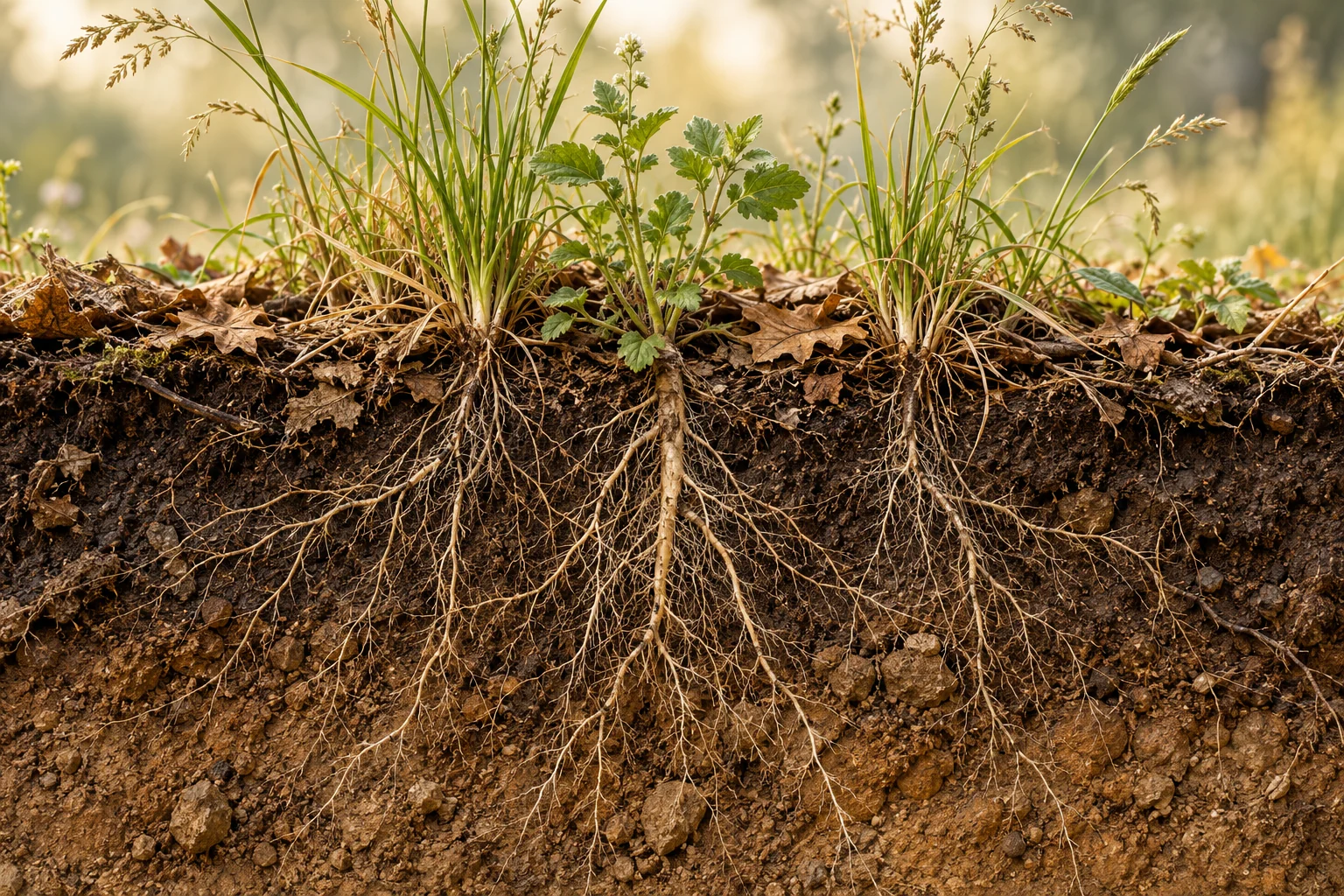
Litter is dead plant material that reaches the soil surface. It can include leaves and other plant remains. Living plants, by contrast, explore the soil through their roots. Around those roots, in the region known as the rhizosphere, plants and microorganisms occur in particularly close proximity. Plant-derived carbon therefore reaches this zone through a different pathway from material initially deposited on the surface.
This distinction concerns the pathway of input, rather than a ranking of good and bad practices. An organic surface layer and living vegetation are different conditions. Soil covered with organic material may still spend long periods without living roots. Conversely, visible greenery does not remove the need to examine the soil. A sound assessment asks what connection actually exists between plants, organic inputs and the soil beneath them.
What changed in the long-term field experiment
The research team compared different treatments over 13 years. Litter was added to or removed from experimental plots; living vegetation was eliminated from others. The experiment also included combinations of these interventions and untreated comparison plots. This allowed the researchers to investigate changes in aboveground inputs and the presence of living plants within the same grassland system. Its duration distinguishes the experiment from a short-term observation following a single material application.
The researchers examined bacteria, fungi and protists, alongside soil properties and several soil functions. Selected functional measurements were also combined into an index of ecosystem multifunctionality. The idea behind this term is to consider several measured properties together. The index makes comparisons easier to follow but does not describe every service the ecosystem provides. The duration also requires careful interpretation: the 13 years refer to treatment of the plots, not an uninterrupted annual record of all soil life.
Living vegetation had a distinct significance
Where living plants were absent, bacterial and fungal diversity declined, as did the combined multifunctionality index. Statistically derived characteristics of microbial networks also changed. Removing vegetation therefore had consequences in the study system that cannot be described solely by looking at material above the soil surface. The study supports the significance of the active connection between plants and soil.
Adding litter increased multifunctionality without producing a similarly clear rise in microbial diversity. This is not a contradiction: a combined functional index and the diversity of particular groups of organisms measure different aspects. Removing litter also reduced bacterial and fungal diversity. The findings therefore justify neither dismissing litter as ineffective nor assuming the same ranking of treatments for every measurement. The result is more nuanced than a claim that only one form of carbon input matters.
Diversity and soil function are connected, but they are not identical
Soil can be described through its communities of organisms and through measured functions. These perspectives complement one another, but they are not interchangeable. An improvement in a functional measure does not automatically mean that every group examined becomes more diverse. Nor can a single diversity value reveal the entire condition of a soil. The study illustrates this distinction by examining several levels together.
In the analytical models, fungal diversity in particular was associated with soil functions. This directs attention towards an important component of soil life. It is not, however, an instruction to increase an arbitrary fungal count and thereby guarantee a particular outcome. The relationships observed must be interpreted within the experimental design. This restraint is useful in practice: an individual biological indicator cannot replace an understanding of the site or an assessment of the intended development.
The limits are part of the central finding
The experiment took place in one particular semi-arid grassland. It was not a direct comparison of every form of mulch, compost, cover crop or management system. It therefore identifies neither a plant mixture suitable everywhere nor a general increase in yield. Nor did it establish a fixed quantity of permanently stored carbon that could be attributed to arbitrary measures on other sites.
Removing living plants also changes more than a single carbon flow. Several site conditions change along with the vegetation. The experiment therefore does not isolate the effect of a particular root exudate. This limitation does not strip the findings of their value; it defines which conclusions are defensible. The importance of living vegetation in the study system is well supported. A universal prescription for every landscape would be a further step that this experiment cannot establish.
What RED takes from this for planning
For RED, the study adds a planning question: alongside the type and amount of material applied, we should consider when and where living roots are present. Which vegetation suits the intended land use? In which seasons can it develop? Where do long periods without vegetation arise? These questions connect the visible soil surface with plant development over time. They are implications for planning, not management instructions tested in the study.
At dry sites especially, water availability and potential competition belong in this assessment. A blanket requirement for year-round greenery would be too simple. Natural dormant periods, land-use objectives and plant suitability remain important. It makes sense to judge changes against a clearly described starting point: what do we want to improve, how should the proposed measure contribute, and which observations would show that our expectation is not being met?
Complementary tools rather than a single solution
The study shifts attention from material application alone towards the interaction between vegetation and soil. It does not diminish the value of mulch or compost. Instead, it shows why an assessment limited to the surface can remain incomplete. Living plants establish a connection within the system that deserves explicit consideration when planning soil development.
The cautious practical conclusion is therefore to assess organic surface layers, site-appropriate vegetation and actual soil development together. The useful combination depends on the site and the project's objectives. The study provides an important starting point and a justified question for our work: are we planning only what we put onto the soil, or also how living plants remain connected with it?
Scientific source
Jiayin Feng; Linlin Wang; Changchun Zhai; Lin Jiang; Yunfeng Yang; Xiaowei Huang; Jingyi Ru; Jian Song; Limei Zhang; Shiqiang Wan (2024): Root carbon inputs outweigh litter in shaping grassland soil microbiomes and ecosystem multifunctionality. npj Biofilms and Microbiomes 10, 150.
DOI: 10.1038/s41522-024-00616-3
Open the freely accessible original publication
Editorial interpretation: This article explains a scientific publication. The RED practice sections identify ideas drawn from the findings; they are not results of an experiment conducted by RED.