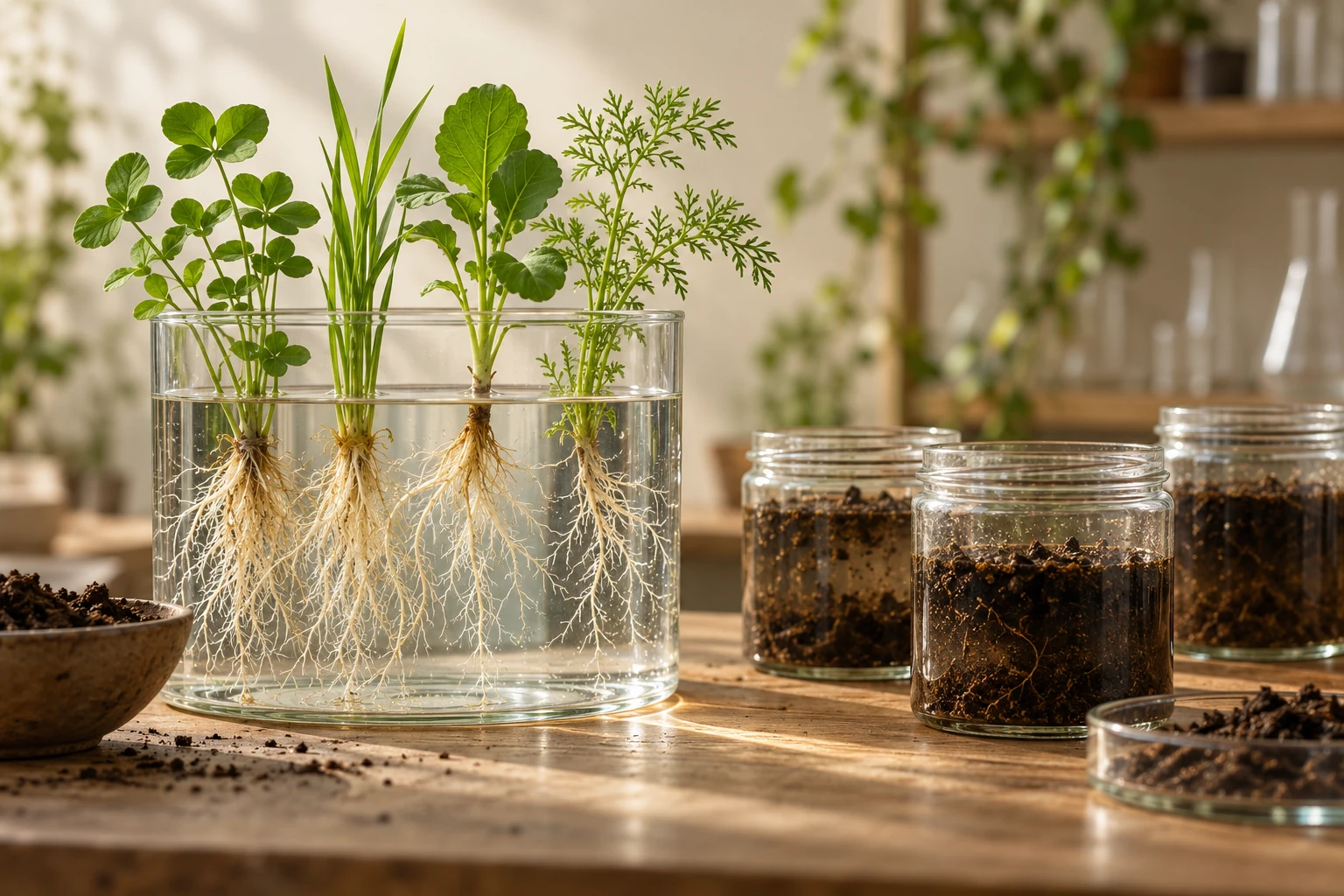
More than a green cover
Cover crops are often judged by what can be seen above ground. How quickly does the stand close? How much biomass does it produce? Does it fit the rotation and protect a field that would otherwise remain bare? These questions matter, but they describe only part of the relationship between plants and soil. Living roots also help shape a chemical environment below the surface. Two crops can therefore interact with soil in different ways even when their visible cover appears similar.
A study published in 2024 by Valerie A. Seitz and colleagues examines this less visible connection. The researchers compared root exudates from four cover crop species and followed the responses of an agricultural soil microbiome. Their question was not which crop produces the highest yield. They asked whether different plant-derived chemical mixtures lead to different microbial functional trajectories. For RED, this adds another dimension to plant selection: alongside rooting patterns, soil cover and the growing season, the chemical resources and signals released by a plant also deserve attention.
What roots release into their surroundings
Root exudates are substances released by living roots into their immediate surroundings. These mixtures include sugars, organic acids, amino acids and other plant compounds. Some can provide resources for microorganisms, while others participate in signalling and metabolic processes. Calling this a chemical language is a useful image, but it should remain a metaphor. A root does not issue simple instructions to soil organisms, and the compounds it releases do not all perform the same task.
The response depends on the interaction between the mixture, the organisms already present and their environment. Compounds may be taken up, transformed or passed through further processes; others may have little effect under the conditions encountered. Root biomass alone cannot describe this exchange. Nor can the detection of one compound explain the influence of an entire plant. The study treats exudates as different chemical starting points and asks how microbial functions develop in response. This makes both the composition of the input and the receiving community important.
Four plants in a simplified soil system
The researchers compared sorghum, hairy vetch, rapeseed and cereal rye. Exudates from these four plant sources were collected, chemically characterised and added to agricultural soil. A comparison treatment received no exudates. Chemical measurements were combined with analysis of microbial gene activity, allowing the team to follow changes in both the substances present and the metabolic functions being expressed. The design was intended to separate chemical inputs from many other effects of a growing crop.
The original paper describes exudates collected from hydroponically grown plants and aerated soil-water microcosms. Inputs were added over six days, with observations continuing for 21 days in total. There was no complete cover crop stand growing in an intact field rhizosphere inside these vessels. The simplified system makes the effects of the added mixture easier to investigate. It does not reproduce all the conditions or continuing feedbacks between a living plant and its soil. This is a controlled investigation of a mechanism, rather than a field recommendation ready for direct adoption.
Microbial function has a history over time
The four exudate sources produced different chemical and microbial functional trajectories. Particularly distinct responses appeared with sorghum and cereal rye. The relevant result was not simply the presence of a substance or an activity at one moment. Its development over time also mattered. A state observed soon after an addition may differ from a later phase, once readily available compounds have been used or transformed into something else. Timing is therefore part of the biological question.
This perspective also changes how a microbiome is understood. A list of organism names does not fully describe what a community is doing. Even broadly similar communities can express different functions under different conditions. Conversely, a change in a chemical concentration does not by itself identify every organism responsible or establish the whole sequence of reactions. Combining measurements brings these relationships into sharper focus. It supports considering plant chemistry and microbial activity together, while leaving room for further work on the mechanisms that connect particular inputs to particular outcomes.
Nitrogen and plant hormones are different levels of evidence
The responses included microbial pathways involved in nitrogen cycling and in the production or transformation of plant-active hormones. Exudates therefore affected more than a general measure of greater or lower biological activity. They were associated with differences in the functions expressed under the experimental conditions. Different chemical inputs can influence different microbial tasks, rather than simply increasing every process in the same direction. This is a more informative question than whether a crop stimulates soil life overall.
However, gene activity is not a direct measurement of the additional nitrogen ultimately available to a crop. Changes in hormone metabolism likewise do not establish a plant growth benefit in the field. Several steps connect a molecular response, a material flow and an observable change in plant performance. For RED, keeping these levels separate is useful. It allows an interesting mechanism to inform future decisions without presenting it as a proven outcome. Whether a functional response becomes a desirable, measurable benefit under local conditions remains a question for suitable comparisons and observations.
A stronger response does not identify the best cover crop
A pronounced response makes a plant source interesting to investigate; it does not automatically make that plant the best option. The experiment does not provide a universal ranking of sorghum, hairy vetch, rapeseed and rye. A useful choice also depends on the function needed at a site and on the other characteristics of the crop. Establishment, seasonal fit and water availability can determine practical success more strongly than an exudate profile that stands out in a laboratory comparison.
The investigation also does not establish long-term soil carbon gains or higher yields from a particular mixture. It measures responses to collected chemical inputs within a limited soil system. Different soils, growth stages and environmental conditions could change those relationships. The supported conclusion is more specific: cover crops differ in their chemical offerings, and these differences can influence microbial functions. What follows at a particular location requires further evidence. Chemistry expands the basis for a decision, but cannot replace consideration of the whole production system or the goals of a project.
Plant selection as a testable RED hypothesis
Planning a cover crop still begins with the starting conditions. How much growing time is available? Which soil functions need support? Where do limited water, bare periods or establishment difficulties constrain the options? These questions identify the species and combinations worth considering. Exudate chemistry adds a further possibility: functional diversity may include different chemical interactions with soil organisms. It does not, by itself, demonstrate that a proposed mixture will provide the intended combination of benefits.
A useful approach is to record the expected effect before making a change and then document what actually happens. Stand development, ground cover, moisture conditions and the following crop can be considered together. A positive result should not be assigned solely to exudates when shading, rooting and residues also changed. This is RED's editorial application of the study, rather than a field protocol tested by its authors. It connects the scientific insight with accountable project development: choose plants deliberately, observe their performance and refine the explanation as further experience becomes available.
Scientific source
Valerie A. Seitz; Bridget B. McGivern; Mikayla A. Borton; Jacqueline M. Chaparro; Meagan E. Schipanski; Jessica E. Prenni; Kelly C. Wrighton (2024): Cover crop root exudates impact soil microbiome functional trajectories in agricultural soils. Microbiome 12, 183.
DOI: 10.1186/s40168-024-01886-x
Open the freely accessible original publication
Editorial interpretation: This article explains a scientific publication. The RED practice sections identify ideas drawn from the findings; they are not results of an experiment conducted by RED.