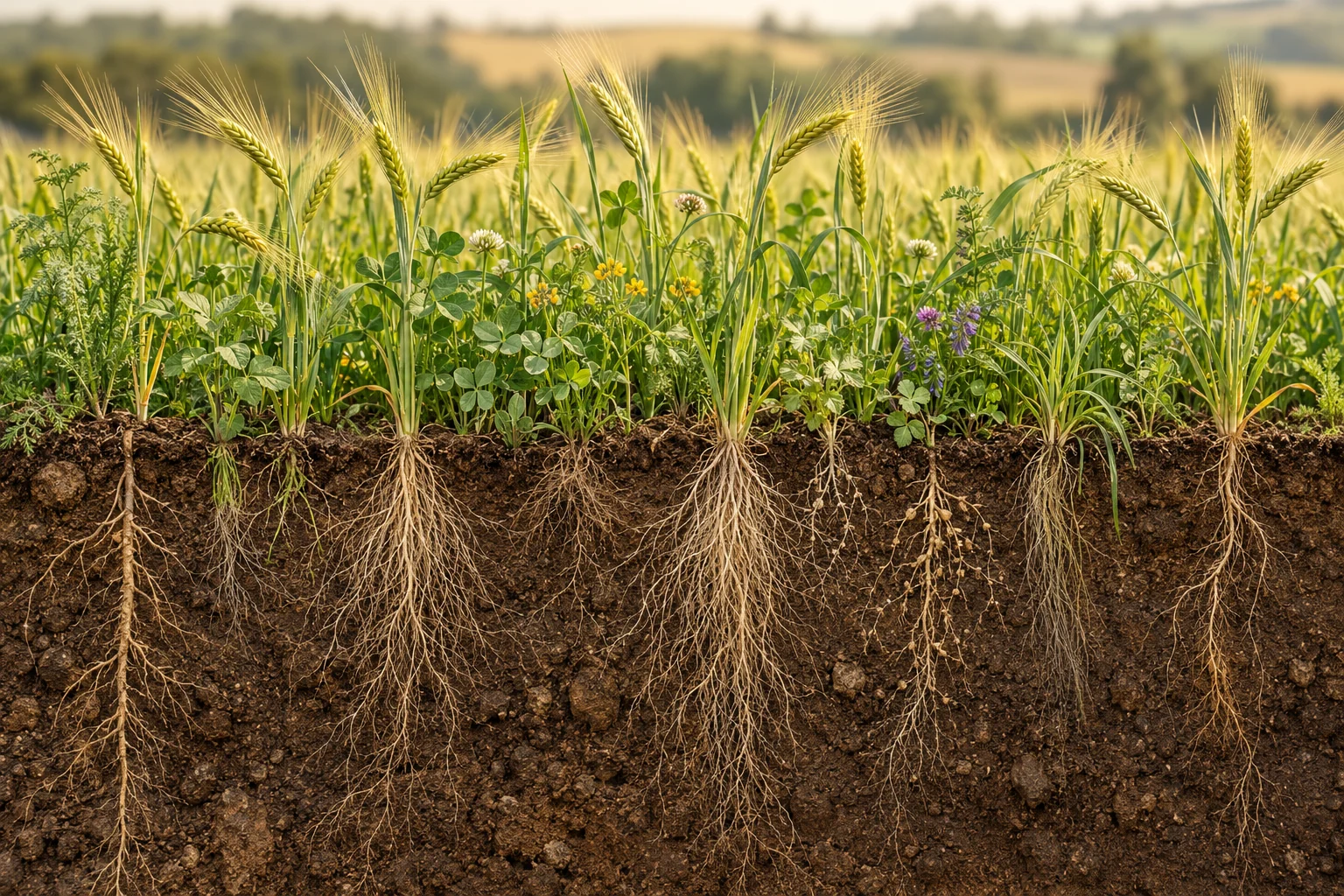
Diversity begins between the rows
A barley field can be more than an area for barley. Other plants can grow between the rows, with roots that explore the soil in different ways. For agriculture, this raises a practical question: can additional functions be integrated into a crop without impairing the main crop? A field experiment in Finland connects this question with the life found immediately around plant roots.
The study therefore considers plant diversity as more than a count of species above ground. It asks whether different companion plants change microbial associations in the barley rhizosphere and how this relates to carbon use. The findings offer a view of processes that are not readily visible when looking at a field. They also show why diversity should be designed deliberately and its effects assessed carefully.
A field experiment with a main crop and undersown plants
In the TwinWin experiment near Helsinki, barley was grown alone or together with undersown crops of varying diversity. Companion species were selected by function: they differed in rooting depth and in their capacity to fix nitrogen. This created a comparison that goes beyond simply contrasting a monoculture with one mixture. The researchers examined a gradient of diversity within an agricultural system.
The investigation discussed here focused on soil adhering directly to barley roots. This rhizosphere is shaped by the connection between the plant and soil life. The research team combined measurements of microbial carbon use with analyses of bacterial and fungal communities, statistical networks, soil carbon and plant biomass. Several levels were therefore considered together, rather than inferring how the whole system works from a single soil property.
Why plant functions matter
A deep-rooting companion plant brings different properties from a shallow-rooting one. The ability to fix nitrogen also distinguishes plants functionally. Such traits are more useful for designing mixtures than species numbers alone. They suggest how plants might use the available space and resources. Whether they actually complement one another must nevertheless be tested at the site.
The authors also discuss how more diverse plant communities may supply different substances through their roots and plant residues. This could change the conditions experienced by microorganisms and the associations between them. It is one possible explanation for the observed patterns. However, the study does not trace every individual material flow or directly show which organism supports another. The distinction between a plausible explanation and direct evidence remains essential.
What carbon use efficiency means
Microorganisms need carbon for metabolism and to build new biomass. Some of the carbon they use is released as carbon dioxide through respiration, while another portion enters microbial biomass. Carbon use efficiency describes the share of this total use that goes into growth. Under the measurement conditions, a higher value means that more carbon enters biomass relative to the amount respired.
This efficiency is relevant to the carbon cycle, but it is not a complete budget. On its own, it tells us neither how much carbon enters a soil overall nor how long that carbon remains there. Further processes lie between a current process measurement and lasting storage. A higher efficiency should therefore not be translated directly into a particular amount of humus or a guaranteed climate benefit.
Which changes were observed
The team observed higher microbial carbon use efficiency with greater undersown diversity. Statistical relationships within the microbiome also shifted: positive associations increased relative to negative ones. The more diverse treatments additionally had higher organic carbon content in the barley rhizosphere. Additional plant diversity was thus associated with several changes beneath the soil surface.
The findings suggest that plants may influence the carbon cycle through more than the amount of biomass they produce. Changes in the microbial community are also a possible part of the explanation. The statistical analysis supports this interpretation, but it does not establish every individual connection. Moreover, carbon content in the root zone studied is different from a carbon stock measured across the entire field over a period of years.
A positive association is not yet proof of cooperation
An association network shows which microbial groups occur together or display opposing patterns in the samples. Positive relationships can be consistent with mutual support. However, they may also arise because several organisms prefer similar environmental conditions. Shared abundance patterns therefore cannot establish with certainty that the microorganisms concerned cooperate directly.
The findings should not be extended indiscriminately to every part of the microbiome either. The network changes described mainly concerned bacteria; corresponding responses were not observed in fungal networks. These differences are part of what makes the study interesting: plant diversity does not necessarily change every element of soil life in the same way. Without that context, saying that there is “more cooperation in the soil” would go too far.
Yield, competition and limits to transferability
Across the period studied, higher diversity was not associated with a significant overall decline in barley yield. This matters in a system combining a main crop with companion plants. It does not mean, however, that every additional species is unproblematic. Plant identity played a role; some companion species can compete more strongly with the main crop than others.
The site also imposes limits. A northern European barley experiment does not directly establish which mixture will suit a dry Mediterranean system. Water availability, growing periods, soil and management differ. A useful complement may become a competitor under other conditions. Nor can this investigation establish a universally optimal species number or carbon storage secured over decades.
What RED draws from this for practice
For RED, this suggests a reasoned approach to further development: first clarify the intended function of additional plants. Is the aim longer soil cover, different rooting zones or plants that complement the existing crop? Species suited to the site can then be selected. A longer species list is not, by itself, a mark of quality.
This practical inference goes beyond the direct experimental findings. Small comparison plots can be used to document establishment, soil cover, visible competition and yield together. Water demand deserves particular attention in dry systems. Such observations do not replace measurements of microbial carbon use. They do, however, help assess a mixture transparently and feed experience into the next decision. The study offers a direction that can be tested, not a ready-made mixture for every soil.
Scientific source
Luiz A. Domeignoz-Horta; Seraina L. Cappelli; Rashmi Shrestha; Stephanie Gerin; Annalea K. Lohila; Jussi Heinonsalo; Daniel B. Nelson; Ansgar Kahmen; Pengpeng Duan; David Sebag; Eric Verrecchia; Anna-Liisa Laine (2024): Plant diversity drives positive microbial associations in the rhizosphere enhancing carbon use efficiency in agricultural soils. Nature Communications 15, 8065.
DOI: 10.1038/s41467-024-52449-5
Open the freely accessible original publication
Editorial interpretation: This article explains a scientific publication. The RED practice sections identify ideas drawn from the findings; they are not results of an experiment conducted by RED.