A perspective article, not an effectiveness trial
The paper by Sáez-Sandino and colleagues is neither a single field experiment nor a systematic meta-analysis. It is a scientific perspective article: the authors connect current research on soil microbiomes, plant productivity and organic matter, and use it to propose new restoration tools and research questions.
This type of article is important to interpret correctly. It can integrate mechanisms and identify innovative pathways, but provides no common effect size for how much carbon a particular inoculum builds. Claims such as ‘microbes reliably store X tonnes per hectare’ cannot be derived from it.
Its strength is the systems perspective: soil organisms influence what happens to plant residues and root exudates. Plants, in turn, determine how much fresh carbon enters the soil. Minerals, pore structure, moisture and disturbance determine how much remains for longer.
The positive feedback loop of regeneration
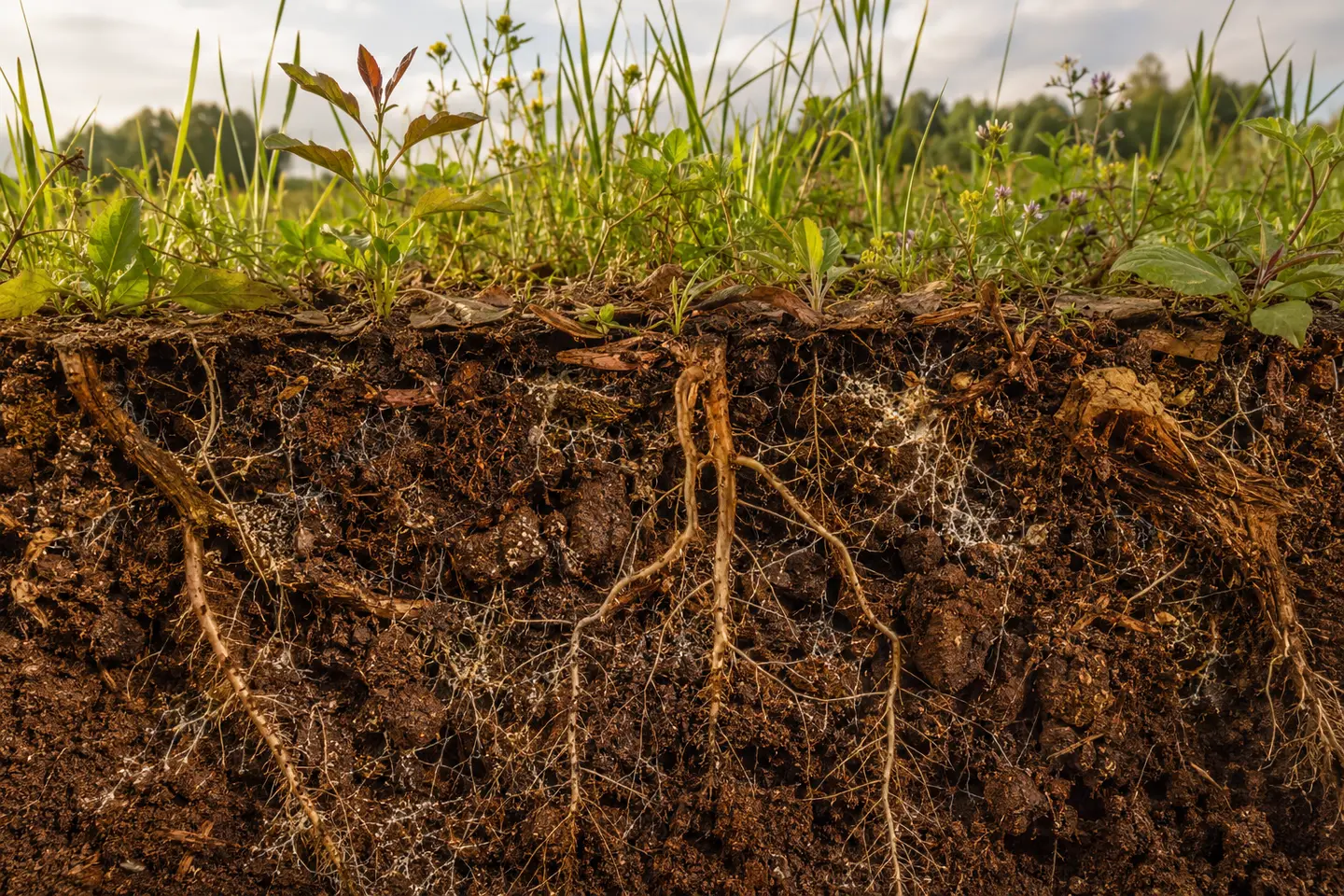
Greater soil biodiversity and favourable structure can improve water and nutrient supply, allowing more plant biomass to grow. More roots, exudates and litter in turn provide substrates for microorganisms. Their metabolites and dead cellular components can promote aggregation and organic matter. If this loop becomes stable, the system supports its own development.
Degradation can reverse the same feedback: sparse cover causes heat, erosion and low carbon inputs; this limits soil life and structure; plants establish even less successfully. Restoration measures must therefore often address several bottlenecks simultaneously.
The perspective article views microorganisms not as a substitute for plants, but as mediators. Without new photosynthetic carbon, no microbial preparation can permanently build large stocks. Without suitable microbes and mineral protection, additional biomass can in turn be rapidly lost as carbon dioxide.
Organic matter is not a single storage pool
In simplified terms, soil organic matter can be divided into fractions with different levels of protection. Particulate organic matter, commonly called POM, consists more of recognisable plant and organism residues. It can supply nutrients and influence structure, but is comparatively easy to decompose.
Mineral-associated organic matter, MAOM, often consists largely of small, microbially processed molecules and cell residues bound to clay minerals and metal oxides. This binding can protect carbon for longer. Even ‘stable’ does not mean unchanging; environmental conditions and mineral surface capacity impose limits.
Microbes can therefore decompose and build at the same time. They respire some absorbed carbon as carbon dioxide and use the rest for biomass and metabolites. After cell death, necromass develops and may contribute to MAOM. The balance depends on substrate, community, nutrients, moisture and mineral capacity.
Which microbial tools are proposed
One tool is growth-promoting microorganisms that support roots, nutrient uptake or stress responses. Instead of a single strain, synthetic communities – SynComs – can combine several selected functions. Their members are deliberately assembled, for example, to mobilise phosphorus, stimulate roots and limit pathogens.
A second route is to manipulate the existing microbiome through management. Plant mixtures, organic materials, minerals, water management or certain metabolites can alter resources so desired functions become more likely. The article also uses the analogy of ‘probiotics’ and ‘prebiotics’: introduce organisms while feeding the appropriate habitat.
A third approach is the transfer of healthy soil. It brings a complex community together with its organic and mineral matrix. This can have strong effects, but requires large amounts of material and can transfer pathogens, pests or invasive species.
Why promising inocula fail in the field
In the laboratory, strains are often selected under optimal moisture, temperature and nutrient supply. These conditions are absent in the field. Local communities occupy niches, clay or organic matter binds signalling molecules, drought interrupts growth, and the suitable host plant may be present only briefly.
An inoculant may also be functionally active but contribute too little to the overall process to produce a measurable area-wide effect. Or it may improve plant growth while also increasing rapid decomposition of existing organic matter. Measuring presence or short-term biomass is therefore insufficient.
What modern methods can contribute
Metagenomics and metatranscriptomics can record potential and active genes respectively. Metabolomics reveals small molecules exchanged by plants and microbes. Metabolic models can use these data to develop hypotheses about complementary organisms and nutrient bottlenecks.
Such methods help select SynComs and understand failures, but do not replace field measurements of organic matter. Carbon stocks must be determined using bulk density and depth profiles; POM and MAOM may need fractionation; and plant inputs must be documented.
The combination is especially informative: omics data explain a mechanism, isotopes track new carbon, fractionation identifies its storage location, and repeated field measurements test persistence.
Why this matters for RED
The article aligns with RED because it does not attribute soil building to a single organism. Plants, microbes, organic inputs, minerals and water form a coupled system. Every biological application therefore needs a habitat-forming measure: living roots, cover, suitable moisture and minimal disturbance.
For RED, a microbial tool would make sense when a clear bottleneck has been identified and its additional contribution is tested against a plant-based baseline system. Success means not merely more microbial activity, but more stable function: better establishment, less erosion, reliable nutrient cycling and demonstrable accumulation of organic stocks.
Open the freely accessible original publication