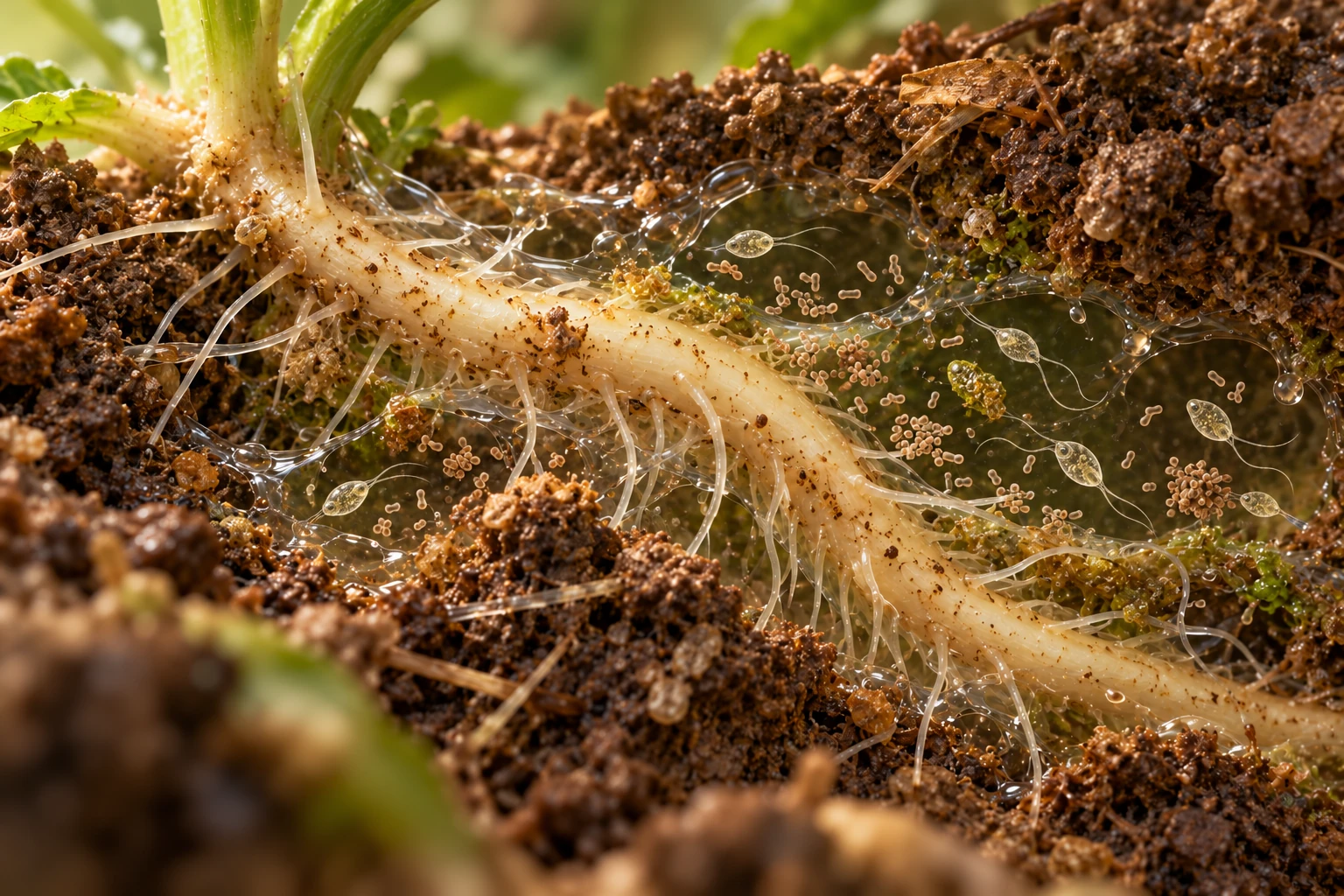
Soil life includes the organisms that eat the microbes
When we imagine living soil, bacteria, fungi and earthworms often come to mind. It includes protists: predominantly single-celled organisms with a nucleus, some of which feed on bacteria. These predators can influence which microorganisms establish themselves around a root. For a plant, the number of bacteria present may therefore be only part of the story. Who eats whom, and which community develops as a result, can also matter.
A study published in 2024 by Sai Guo and colleagues investigates this connection. It focuses on the bacterium-eating protist Cercomonas lenta, cucumber plants and selected rhizobacteria. Rhizobacteria inhabit the zone influenced by plant roots. The researchers asked whether a predator could indirectly create conditions favourable to plants. A particular strength of the work is its combination of experimental levels: changes in the community were connected with targeted microbial experiments and the response of the plant.
A controlled model makes relationships easier to examine
The researchers used greenhouse containers and cucumbers as a model crop. Their soil came from a long-term fertilization experiment. That history does not make the present investigation a field trial: the interventions and measurements discussed here took place under controlled conditions. The first step examined how different additions of Cercomonas lenta affected the bacterial community and plant biomass. Subsequent experiments investigated selected bacteria both separately and in combinations.
Some experiments used living, non-sterilized soil. Others used sterilized soil to distinguish specific interactions more clearly. Simplification is useful when the purpose is to understand a mechanism. At the same time, it removes many relationships that the organisms would encounter in an established soil. The study therefore provides insight into an experimentally manageable model.
More biomass is a finding, not a promise of higher yield
In the first experiment, cucumber biomass increased after the protist was added. Across three inoculation densities, the paper reports an average increase of about 92 percent compared with the treatment without added protists. The individual responses behind that average differed substantially. The figure therefore describes neither every treatment nor a generally predictable outcome. It refers to the growth of the plants examined within that particular experimental design and its comparison conditions.
An impressive number requires precise language. Measured plant biomass is not the same as marketable fruit yield over an entire growing season. The percentage cannot simply be transferred to other crops, soils or management systems. Under sterilized conditions, the protist alone did not produce a corresponding significant change in biomass. This comparison is important because it argues against treating the organism as a growth additive that works independently of soil life. Its effect needs to be understood in relation to the microorganisms involved.
Predation can change the balance between bacteria
The bacterial community shifted after the protist was introduced. Certain representatives of Pseudomonas and Sphingomonas became more prominent, while representatives of Chitinophaga declined. In further experiments, the researchers examined strains from these groups. The protist did not affect all of the selected bacteria equally. Under the conditions tested, the two plant-beneficial partners could develop more successfully relative to their bacterial antagonist.
This does not divide entire bacterial genera into good and bad categories. Each name includes organisms with different properties. Chitinophaga was relevant here primarily as an antagonist of the selected beneficial bacteria; adding it alone did not significantly change plant biomass. The precise conclusion concerns the strains and combinations tested. For RED, the wider idea is valuable: a soil process may change because relationships among organisms change, without merely adding the largest possible number of supposedly helpful microbes.
Building biofilms together can make a difference
Pseudomonas and Sphingomonas formed stronger biofilms in joint culture than in the respective single cultures used for comparison. A biofilm is a microbial community associated with a surface and potentially surrounded by material the organisms produce themselves. The ability to colonize matters around roots. An organism with a useful property under favourable laboratory conditions first needs to establish itself where that property could benefit the plant. The investigation therefore connected bacterial characteristics with the development of the consortium.
The findings support an explanation involving predation pressure, bacterial cooperation and root colonization. They do not mean that every biofilm benefits a plant, or that producing more biofilm is always better. The spatial and chemical conditions around a root also matter. The contribution of the study is to examine a possible connection between community assembly and function experimentally. A simple inventory of which organisms were present would not have revealed that connection with the same degree of clarity.
Phosphorus became more available, but was not created
Another part of the investigation concerned phosphorus. In the final consortium experiment, measured available phosphorus was about 14.5 percent higher with the protist than with the same bacterial combination without it. This refers to a phosphorus fraction extractable under specified analytical conditions. The paper connects the finding with inorganic phosphate mobilization and the activities of the bacteria involved. It therefore provides a possible link between microbial community development and the observed response of the plant.
Mobilization does not create a new nutrient supply. It changes how an existing pool may become accessible under particular conditions. The percentage is consequently not an instruction to reduce a fertilizer rate by 14.5 percent. Such a decision would require information about starting reserves, plant uptake and changes over the growing season, among other factors. In practice, a biological change must be relevant to the resource actually limiting growth. An improved measurement alone does not describe complete nutrient provision or the long-term development of the soil.
A mechanism needs a clearly defined scope
The study goes beyond comparing lists of organisms. It combines community analyses with targeted changes to selected organisms and measurements of plant responses. That makes the proposed chain of effects easier to understand and assess. Nevertheless, one protist species, one model crop and a limited set of bacteria received particular attention. In the field, these relationships encounter changing moisture, temperature, soil structure and many other inhabitants. Both opportunities for establishment and the importance of individual partners may change as a result.
Long-term stability and possible effects on other organisms are also not settled by this experimental design. A promising research candidate is therefore not yet a proven treatment for every application. This bounded scope does not reduce the scientific value of the work. It identifies the questions that a subsequent investigation would need to answer. Practical decisions depend on distinguishing a mechanism observed in a model from the performance that can reasonably be expected at a particular site.
What RED takes from paying attention to predators
For RED, the investigation broadens the perspective on soil development. Roots, organic inputs and nutrient reserves belong to the system alongside competition, cooperation and feeding relationships. They should be considered together when planning an intervention or evaluating a biological product. The central question is not only whether a particular microorganism is present, but under what conditions its relationships with other inhabitants allow a desired function to emerge.
The immediate implication is careful observation and testing, rather than a general recommendation to add protists. A project record can bring together initial conditions, plant development, soil analyses and management changes. Anyone considering a preparation should ask for understandable trials with comparable soils, crops and outcomes. In this way, the study helps formulate better questions. It reminds us that living soil is not defined by a single group of organisms, but by the conditions and relationships through which its inhabitants function.
Scientific source
Sai Guo; Stefan Geisen; Yani Mo; Xinyue Yan; Ruoling Huang; Hongjun Liu; Zhilei Gao; Chengyuan Tao; Xuhui Deng; Wu Xiong; Qirong Shen; George A. Kowalchuk; Rong Li (2024): Predatory protists impact plant performance by promoting plant growth-promoting rhizobacterial consortia. The ISME Journal 18, wrae180.
DOI: 10.1093/ismejo/wrae180
Open the freely accessible original publication
Editorial interpretation: This article explains a scientific publication. The RED practice sections identify ideas drawn from the findings; they are not results of an experiment conducted by RED.