What PGPB are – and what the term does not guarantee
Plant Growth-Promoting Bacteria, or PGPB, are bacteria that can support plants directly or indirectly under certain conditions. They live freely in soil, on root surfaces or within plant tissues. The term describes an observed function, not a uniform group of organisms and not a guarantee that every strain works at every site.
The review by Maciel-Rodríguez and colleagues brings together mechanisms and applications in overused, saline or heavy-metal-contaminated soils. It discusses species from genera including Bacillus, Pseudomonas and Azospirillum. The work covers a broad range of laboratory, greenhouse and field findings.
This breadth demands precision. Results from a single strain must not be transferred to an entire genus. Likewise, an effect on seedlings under controlled conditions is not evidence of long-term soil restoration.
Changing root architecture and stress hormones
Many PGPB produce indole-3-acetic acid or related auxins. At appropriate concentrations, they can promote lateral roots and root hairs, increasing the surface through which plants absorb water and nutrients. Excessive auxin concentrations can inhibit growth; effects depend on plant species and developmental stage.
A second mechanism is ACC deaminase. Ethylene often rises during drought, salinity, flooding or heavy-metal stress and can restrict root growth at high concentrations. Bacteria with ACC deaminase break down a precursor and may alleviate the stress response.
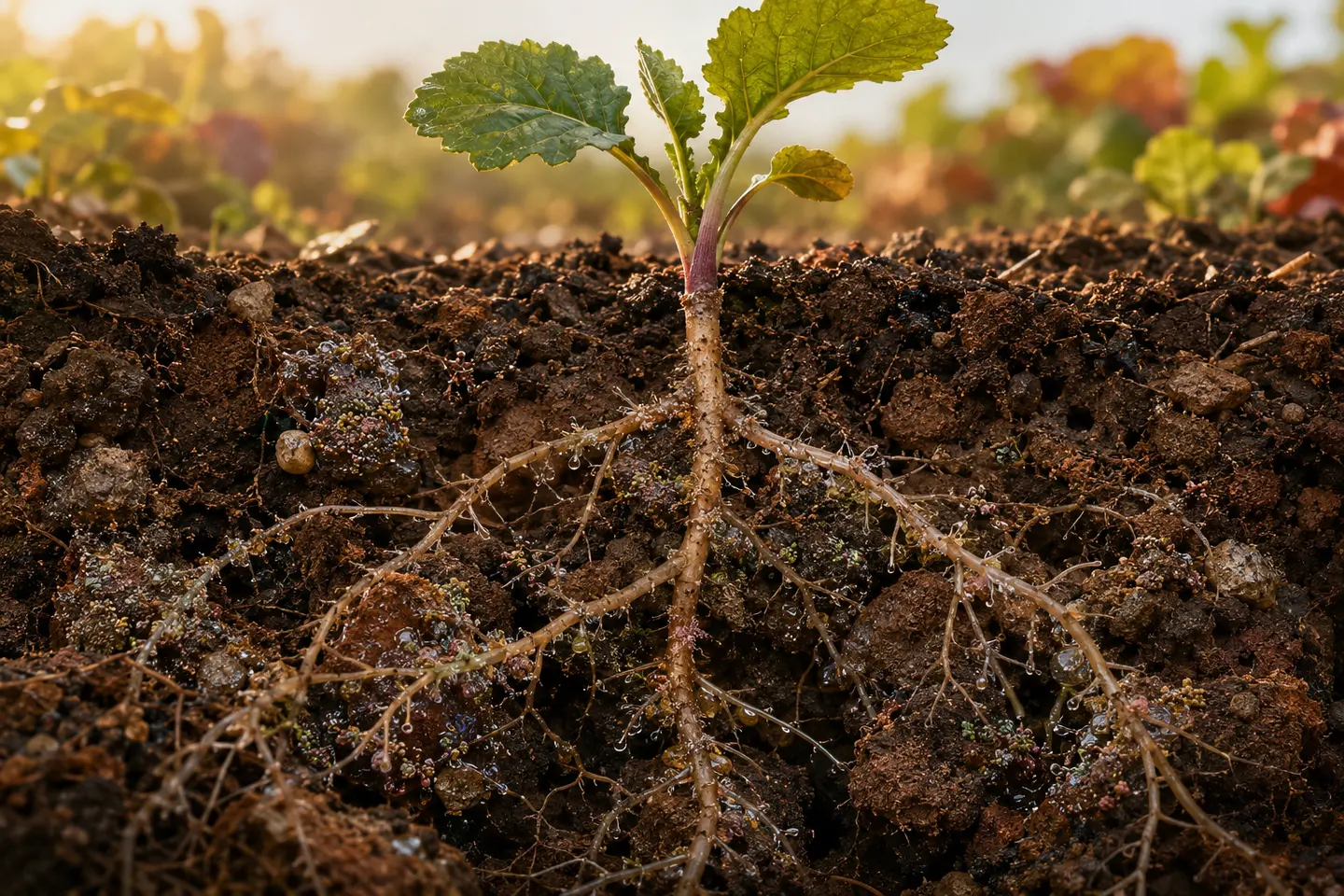
Both mechanisms feed back through the plant into the soil. A larger root system provides more exudates and dead fine roots. PGPB application may thereby influence microbial food supply and aggregate formation indirectly – provided the additional plant growth persists under field conditions.
Mobilising nitrogen, phosphorus and iron
Certain bacteria fix atmospheric nitrogen, some in close symbiosis and others associatively. Other bacteria solubilise poorly available phosphate through organic acids or enzymes. Siderophores bind iron very strongly; they can improve plant iron nutrition while also restricting pathogens through competition.
Mobilisation is not the same as adding to the total stock. Phosphate-solubilising bacteria make existing reserves temporarily accessible but do not replace a long-term nutrient balance. Released nutrients may be rebound, leached or taken up by other organisms.
An effective strain therefore must do more than produce a clear zone on laboratory medium. It must remain sufficiently active at the real pH, with existing minerals, under competition and together with the target plant. Field measurements of plant uptake and nutrient balance matter more than a screening test alone.
Biofilms, signals and biological disease suppression
Extracellular polymers and biofilms help bacteria adhere to roots and soil particles. They can retain water in the immediate environment and bind ions under salt stress. Volatile organic compounds act over short distances on plants or other microbes.
PGPB counter pathogens through competition, siderophores, antibiotics, lipopeptides and degradative enzymes. Some activate plant defences through jasmonic-acid or salicylic-acid signalling pathways. This condition is described as induced systemic resistance.
Such multiple effects are attractive but may be highly context-dependent. An antimicrobial compound may also affect non-target organisms; induced defence costs the plant energy. The balance between protection and growth must be assessed in each system.
Applications in saline and contaminated soils
In saline soils, researchers investigate halotolerant strains that form biofilms, alter stress hormones or support the plant’s potassium–sodium balance. In heavy-metal-contaminated soils, bacteria can bind or transform metals or support plant development in ways that improve phytoextraction or stabilisation.
The objective must be clear. In phytoextraction, metals should enter harvestable biomass; in phytostabilisation, they should remain as immobile as possible. An organism that increases metal availability may help one objective and create risk for the other.
Consortia, fungi and organic carriers
Several PGPB may provide complementary functions. Combinations with arbuscular mycorrhizal fungi, compost or biochar aim to support plant, microbiome and habitat simultaneously. The review describes promising examples, but consortia are not inherently superior to single strains.
Complexity increases with every additional component. Partners may complement one another, remain neutral or compete. Compost and biochar also provide nutrients, surfaces and water-holding capacity themselves. Without suitable controls, an effect cannot be attributed clearly to the inoculum.
Local or site-analogous strains often have better prospects of survival. Formulation – liquid, seed coating, granules or carrier – also determines whether enough living cells reach the root.
The gap between controlled experiment and field
Temperature, moisture and competition are constrained in a greenhouse. In the field, changing weather, UV radiation, soil heterogeneity and established communities all act. An inoculant may be viable at application and fall below detection limits a few days later.
Formulation and storage also change the dose. Some spore-forming Bacillusstrains are more robust than sensitive vegetative cells, but survival alone does not guarantee function. The target plant must be colonised at the right time.
The review therefore calls for longer-term, scalable field studies. Repeated sites and weather years and direct comparisons with existing management measures are particularly important.
Why this matters for RED
PGPB fit the RED approach when understood as a targeted tool rather than a universal soil activator. The process begins with a clear constraint – such as salt stress, missing nodule symbiosis or weak establishment. This is followed by local strain selection, small controlled tests and functional measurements.
The most important lever remains the habitat: living roots, organic carbon supply, water, pore space and minimal harmful disturbance. A bacterium can use or initiate these conditions, but cannot replace them permanently.
Open the freely accessible original publication