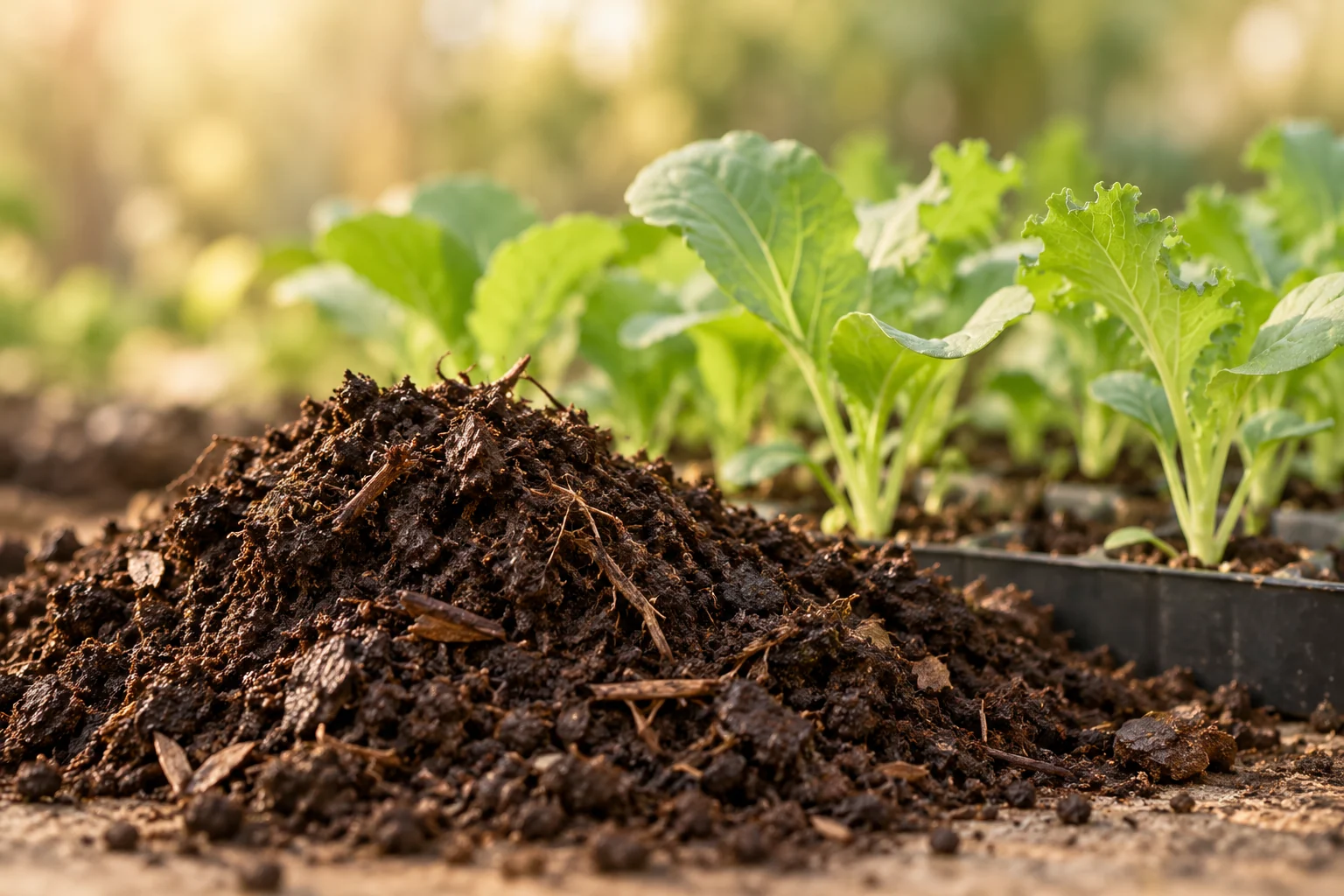
Compost quality starts with the task it needs to perform
Mature compost can return organic matter, supply nutrients and support life in the soil. Growers often hope for an additional benefit: healthier plants and less disease. Reliable planning requires these functions to be considered separately. A material that works well as a soil amendment does not automatically have a demonstrated effect against a particular pathogen. Equally, a useful compost does not lose its value simply because that additional effect has not been shown.
Disease suppressiveness describes reduced damage to plants within a particular disease system. That system includes the crop, the pathogen, the growing medium and the environmental conditions. A study published in 2025 by Anja Logo and colleagues makes this distinction especially clear. It compares a range of real composts and examines whether material properties and microbial communities can help explain their effects. For RED, this is fundamentally a question about verifiable quality.
What the researchers compared
The team studied 37 composts from seven commercial producers, assessed in four separate sampling sets. Three combinations were tested: cress with Globisporangium ultimum, cucumber with the same pathogen, and cucumber with Rhizoctonia solani. This creates two useful comparisons. The host plant can change while the pathogen stays the same, or a different pathogen can be examined with the same host. That is more informative than a single successful result with one crop.
Plants were grown in controlled substrate experiments. The researchers also measured physicochemical properties, microbial activity, and bacterial and fungal communities. Three additional compost samples had been excluded because they inhibited cress growth even without pathogen addition. The final set therefore consists of materials that passed that initial screening. This was neither a representative market survey nor a multiyear field trial. It combined targeted functional testing with detailed descriptions of the selected materials.
A frequent potential, with a clearly defined reach
Of the 37 composts, 33 significantly suppressed disease relative to the no-compost control in at least one system. Only three did so in all three systems. Four showed no significant effect in any of them. This distribution matters more than a single success figure. It shows how an assessment changes when several plant–pathogen combinations are considered rather than treating suppressiveness as one universal property.
Effects depended mainly on the pathogen and, to a lesser extent, on the host plant. A compost that performed well in one test did not necessarily perform equally well in the next. Even the three consistently successful materials were assessed only for the combinations tested. Conversely, a nonsignificant difference is not proof of complete ineffectiveness in every situation. These findings identify meaningful potential whose limits need to be stated. They cannot be converted into a general success rate for gardens, farms or all compost products.
What improved seedling growth actually tells us
One assessment related the shoot weight of plants receiving a pathogen to comparable plants grown without it. Disease symptoms were also examined. This places the plant response at the centre of the test: how strongly does the disease system impair growth, and can compost reduce that impairment? It does not simply count microorganisms and equate a large number with healthy soil or reliable crop protection.
Reduced disease damage also does not mean that the pathogen has disappeared. Under some conditions, plants may cope better with a burden that remains present. Three practical questions therefore need separate answers. Is the material compatible with the plant? Does it support growth? Does it reduce damage from a particular pathogen? These properties can coincide, but they need not. Recording them separately makes it easier to understand a favourable result and to identify exactly what an experiment can support.
Why activity and maturity cannot answer every question
The researchers examined 14 physicochemical properties, alongside basal respiration and FDA hydrolysis, an enzyme activity assay, as measures of microbial activity. Neither these individual measurements nor compost age provided a reliable general prediction of average suppressiveness. A particularly active material was therefore not automatically the right material for the disease system being tested. The study did not establish a single simple value that could serve as a universal quality indicator.
Such measurements remain useful in practice. Plants need suitable nutrient conditions, differ in their tolerance of salts and can respond poorly to unsuitable growing media. Chemical and biological descriptions help identify possible uses and detect problems. They answer a different question from a targeted effectiveness test, however. RED therefore draws a complementary lesson: assess general material quality and examine specific functional claims in a suitable system. An acceptable laboratory result is valuable information, while the desired additional effect still needs appropriate evidence.
Microbial clues are starting points for further research
Comparisons of highly and weakly suppressive composts identified interesting microbial candidates. For Globisporangium ultimum, these included bacteria from the genera Luteimonas, Sphingopyxis and Algoriphagus; for Rhizoctonia solani, members of Actinomycetota stood out. These names describe associations between the communities examined and the observed effects. They provide directions for further investigation rather than a ready-made list of products to use.
An organism that occurs more frequently need not cause the effect itself. It may indicate particular conditions, accompany other organisms or matter only through interactions within a community. Its presence does not justify recommending it as a standalone inoculant. Adding one species does not automatically recreate the original compost system. A candidate becomes more useful for applications when its function has been demonstrated and its effect observed repeatedly under relevant conditions. The connection between a description and a verified performance is the essential next step.
How RED can use these findings
A RED project starts with its intended purpose. Is compost meant primarily to support soil development, supplement a propagation medium or suppress an identified disease? Materials and supporting evidence can then be selected according to that task. Origin, batch identity, maturity, storage and observed plant responses belong in the project record. Earlier positive experience is helpful, but remains connected to the conditions under which it was gained.
A specific disease problem calls for a sound diagnosis and suitable comparisons conducted with appropriate expertise. Controlled results do not establish what will happen after storage, application and exposure to local conditions. RED therefore favours a gradual approach: state expectations, select compatible materials, make manageable comparisons, and record results together with uncertainty. This allows compost to contribute to a functioning system. Its value becomes visible without attributing properties that have not yet been demonstrated for the crop or application concerned.
Scientific source
Anja Logo; Benedikt Boppré; Jacques Fuchs; Monika Maurhofer; Thomas Oberhänsli; Barbara Thürig; Franco Widmer; Johanna Mayerhofer; Pascale Flury (2025): Analyses of 37 composts revealed microbial taxa associated with disease suppressiveness. Applied and Environmental Microbiology 91(11), e01100-25.
DOI: 10.1128/aem.01100-25
Open the freely accessible original publication
Editorial interpretation: This article explains a scientific publication. The RED practice sections identify ideas drawn from the findings; they are not results of an experiment conducted by RED.