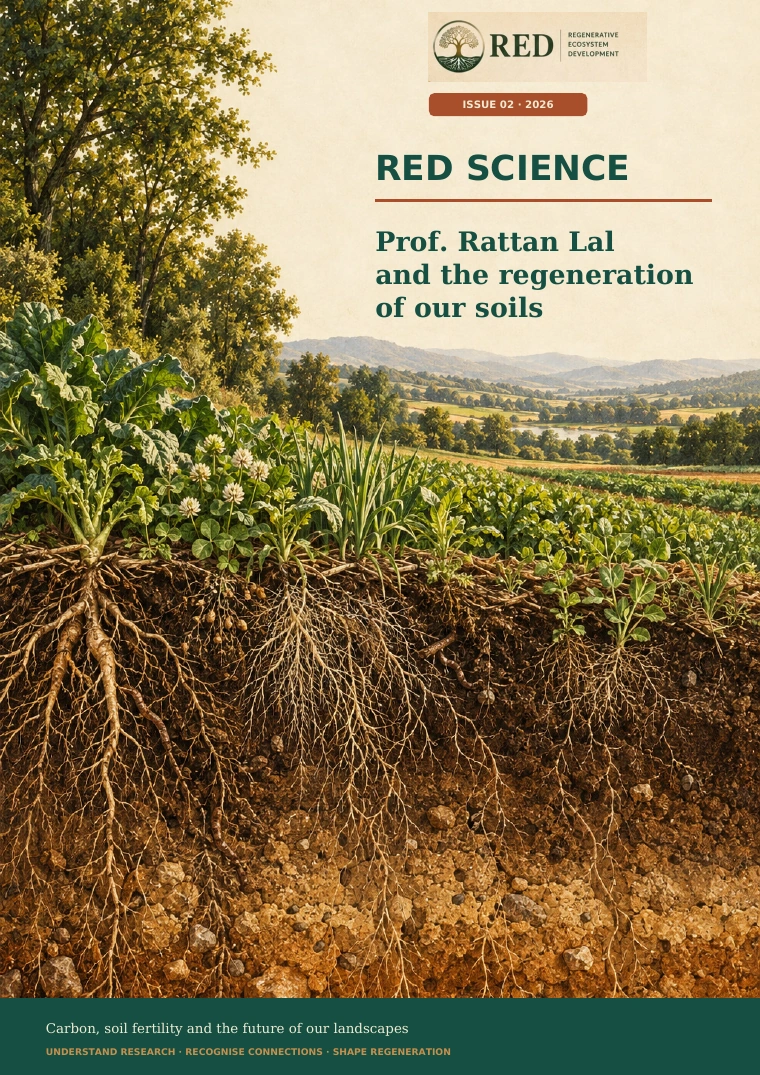
This web edition summarises selected content in ten themes. The 32-page Premium issue includes the detailed discussions, all diagrams, a glossary with page references and the complete reference list.
What remains of life in the soil? Following the first issue on Elaine R. Ingham and the soil food web, RED Science follows carbon further: from plants and microbial processing to soil structure, management and measurable change. Rattan Lal’s research provides the main thread. Studies by other teams broaden the perspective; RED’s practical questions and teaching examples remain identifiable as its own editorial applications.
Connecting soil conservation, production and livelihoods
Rattan Lal’s scientific journey took him from India through the United States and Australia to Nigeria, and back to Ohio State University. These different locations illuminate a central question in his work: how can management improve soil properties and people’s livelihoods together?
His field studies examine specific interventions; broader publications connect soil structure, organic matter, food security and climate. His 2004 Science article discussed rebuilding lost soil carbon within this context. Recognising the importance of his contribution does not replace examining individual claims. Their scope emerges from the relevant study, its methods and the conditions investigated.
What the Ibadan mulch trial shows – and what it does not
In 1976 and 1977, a team involving Lal compared an unmulched control with four amounts of rice straw on newly cleared soil near Ibadan. The mulch was renewed twice yearly. No crops were grown on the small sloping plots; vegetation was suppressed chemically. The main soil measurements concerned the upper five centimetres.
Greater mulch cover better preserved measured properties such as pore space, aggregate stability and hydraulic conductivity. Chemical soil fertility nevertheless declined, more slowly with higher mulch amounts. The trial therefore demonstrates protection under its particular conditions – neither the restoration of a forest nor a carbon gain achievable everywhere.
Carbon is not the same as humus
Soil organic carbon, or SOC, is the carbon component of soil organic matter, SOM. Organic matter contains other elements and widely differing materials. Two per cent SOC therefore does not mean two per cent organic matter. A fixed conversion remains an approximation; in carbonate-containing soils, inorganic carbon must also be distinguished analytically.
In agricultural usage, humus often means soil organic matter, not a uniform, unchanging substance. Laboratory comparisons require a known measurement, reference mass and sampling depth. Soil fertility cannot be reduced to an SOC target either: nutrient supply, water and rooting conditions also matter. An intervention should address what actually limits plant growth.
From plant growth to microbial processing
Plant carbon enters soil through litter, dead roots and dissolved substances released by living roots. Location matters: root material already encounters mineral surfaces, organisms and varying spatial conditions within the soil. Dense above-ground vegetation does not, by itself, describe rooting throughout the profile.
Soil organisms process these inputs. Some carbon is respired as CO₂; some enters biomass temporarily or remains in products and microbial residues. The MEMS framework connects this processing with the soil’s mineral matrix. It describes a relationship, not a guaranteed pathway for every particle. Activity, biomass formation and long-term storage therefore need to be considered separately.
Considering quantity, form and function together
Particulate organic matter, POM, often contains recognisable or partly decomposed organic particles. Mineral-associated organic matter, MAOM, is closely associated with minerals. This distinction helps us examine formation, functions and responses to management more precisely. The boundaries between fractions nevertheless depend on the laboratory procedure.
Mineral association does not explain persistence alone. Accessibility, spatial arrangement and environmental conditions affect whether microorganisms can process material. POM also performs functions and is not a worthless precursor. A higher total value does not reveal the form in which additional carbon occurs. Assessment therefore needs quantity, form and function, alongside the question of whether inputs can be sustained.
Soil structure, water and erosion belong together
A review co-authored by Lal describes soil structure as the outcome of interacting processes: roots, organisms, organic matter and minerals shape aggregates and pores. For RED, this raises questions about the profile: where do structure and rooting change? Are pores connected? A photograph of a crumbly handful cannot replace representative investigation.
Complementary research also distinguishes water entering the surface from water later available to plants. More organic matter does not supply the same additional water everywhere. Erosion changes the balance too: material moves and is deposited elsewhere. A higher carbon stock at the foot of a slope therefore does not itself prove additional CO₂ uptake. Soil and landscape need to be considered together.
Management measures need suitable objectives and comparisons
Mulch, cover crops, altered tillage, organic materials and agroforestry affect a system in different ways. Living cover must suit its growing window, water availability and the following crop. For compost or manures, origin, available quantities and nutrients matter; carbon added is not the same as carbon retained over time.
A site comparison involving Lal illustrates why sampling depth matters: enrichment near the surface under no-till did not mean a higher stock across the full profile examined. For agroforestry, previous land use changes what the comparison tells us. This produces no universal ranking. Selection begins with an observed problem and an effect that can be appropriately tested.
Potential needs a frame of reference and time
Lal’s global estimates from 2004 belong to the discussion of soil conservation and climate at that time. They are neither an unchanged current forecast nor a guaranteed annual gain for a field. Estimates of potential require a baseline, depth, area, period and the conditions under which change would be possible.
An approximately constant stock can coexist with substantial carbon turnover. This steady state does not prove complete saturation. Complementary studies distinguish capacities dependent on methods and environmental conditions, rather than a universal storage ceiling. Losses can recur. A practical accumulation target therefore needs not only a time frame but a plan for maintaining the necessary conditions afterwards.
From percentage to a traceable demonstration of change
The full issue’s entirely hypothetical worked example considers one hectare of stone-free soil to a depth of 20 centimetres. Two per cent SOC gives a calculated 52 tonnes of carbon at an assumed dry bulk density of 1.3 tonnes per cubic metre, or 44 tonnes at 1.1. These are neither RED field measurements nor before-and-after results.
Concentration alone therefore does not determine the stock. Demonstrating real change requires a documented baseline, comparable sampling, appropriate soil masses and information about coarse fragments and uncertainty. Spatial differences must not appear as change over time. Even an undetectable difference is informative: effect size, variation and observation period need to be examined together.
Begin with a testable question on your own land
A possible RED field trial asks whether a suitable cover crop shortens a bare-soil period and improves rooting. This is explicitly a planning proposal, not an existing experimental site or a reported result. Comparable areas, replication, random allocation where possible and observations defined in advance make comparisons more informative.
Cover, roots, weather, workload and the following crop are documented together; additional SOC remains a long-term question. The proposal is not a universal protocol. It illustrates a way of working: observe, test an explanation and learn from the outcome. The next issue takes these questions towards Suzanne Simard, trees, fungi and their relationships without anticipating those research findings here.
Read the full issue
RED Premium includes the complete 32-page issue: detailed research discussions, explanatory diagrams, a timeline, a worked example, a possible field trial, a glossary and a reference list with clickable links.
Download the full Premium issue as a PDFEditorial note: This sample is a standalone, condensed web edition of the supplied Issue 02, design version v3 dated 25 September 2026. It distinguishes Lal’s work, complementary research and RED’s editorial teaching examples. Full references and details of source access are provided in the Premium issue; the sample replaces neither that issue nor the original sources.