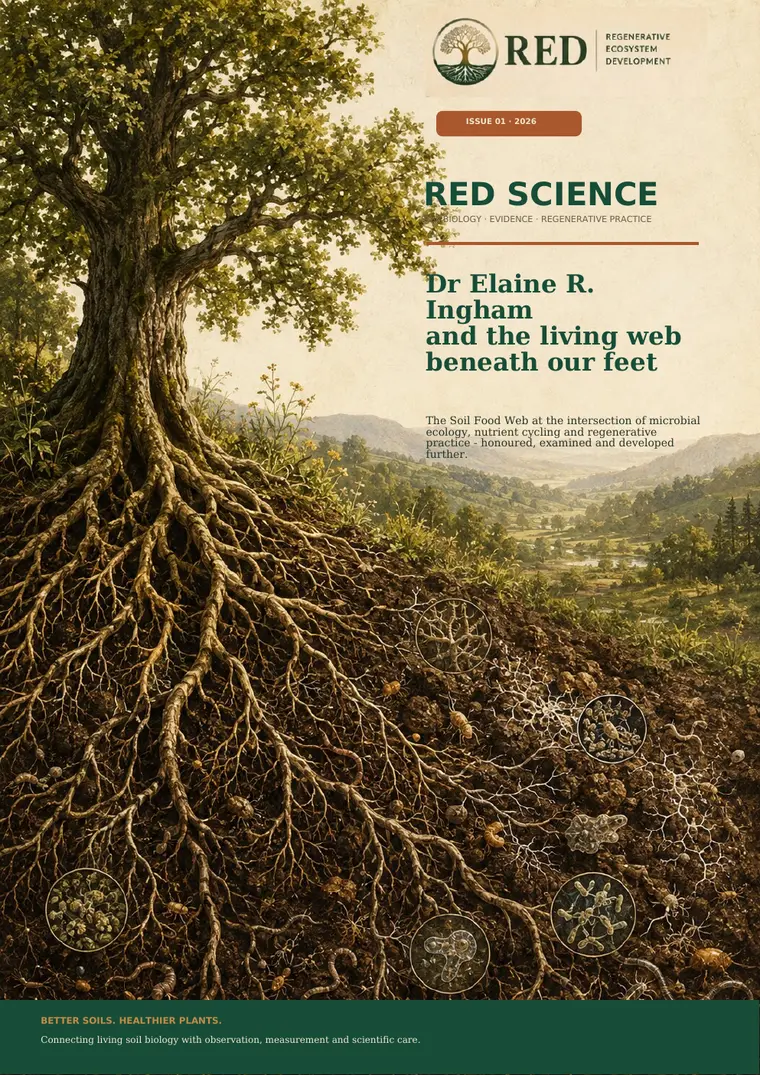
This web edition summarises selected material from the complete issue in ten topic areas. The full 32-page issue contains all graphics, the evidence matrix, a glossary with page references and the complete bibliography.
Soil is not a passive growing medium. It is habitat, reaction space, reservoir and filter. Within its pores, minerals, water, air, roots, organic matter and an almost unfathomable diversity of organisms meet. RED Science examines these relationships scientifically – appreciating influential ideas while applying the same care to their limitations.
Honouring a scientist without turning her teaching into dogma
The first issue of RED Science is dedicated to the work of Dr Elaine Ruth Ingham (1952-2026). Her distinctive achievement was to connect functional groups of soil organisms and communicate complex relationships in ways that enabled farmers, gardeners and restoration practitioners to ask their own questions of the soil.
Scientific recognition does not mean uncritical repetition. Sound mechanisms should be retained, while far-reaching claims continue to be tested. This applies particularly to fixed target values for fungi-to-bacteria ratios, the diagnosis of complex soil functions through light microscopy alone, and the assumption that a biological preparation can reliably correct disease or nutrient deficiency regardless of site.
Fertility is not merely a store; it is a flow
A food web describes how energy and elements move through an ecosystem. In soil, much of this flow begins with plant carbon: roots release organic compounds, while dead roots and litter provide further substrates. Bacteria and fungi process these resources; protozoa, microbivorous nematodes, microarthropods and larger soil animals influence them through grazing, competition and feedback.
For plants, nutrients move between minerals, soil solution, organic matter and living biomass. Chemical analysis remains indispensable. The food-web perspective nevertheless explains why a single concentration measurement can never represent every process across space and time.
Roots help shape their surroundings – they do not control them completely
The rhizosphere is the soil volume directly influenced by living roots. Here plants alter pH and local redox conditions, take up ions and release exudates, mucilage, shed cells and signalling molecules. This rhizodeposition supplies microorganisms with energy and can influence communities, competition and mineral surfaces.
The familiar image that plants “feed” precisely the microbes they currently need is useful but too purposeful. The microbial response also depends on soil type, pH, moisture, pore space, the existing species pool, predation and land-use history. A robust principle remains: maintain living roots and the below-ground carbon flows they support for as much of the year as the site permits.
Not the greatest quantity, but the right function in the right environment
Bacteria and fungi can temporarily immobilise nutrients in their biomass. When they are consumed or die, some of those elements enter other pools. Fungal hyphae can bind soil particles, access complex plant residues and contribute to aggregation together with roots and microbial polymers.
Yet “more fungi” is not automatically better. Fungi include saprotrophic, mycorrhizal, endophytic and pathogenic ways of life. Bacteria also differ greatly in activity, growth rate and function. An isolated fungi-to-bacteria ratio is interpretable only when the method, site, depth, season, substrate and intended process are known.
Protozoa and nematodes set cycles in motion
Microbial biomass alone does not form a functioning food web. Many protozoa consume bacteria; nematodes may feed on bacteria, fungi, plants or other soil animals. Grazing alters populations and can release surplus nutrients. The influential 1985 microcosm study made one such mechanism affecting nitrogen turnover and plant growth experimentally visible.
Moving from a controlled microcosm to the field requires caution. Field soils contain spatial heterogeneity, changing weather, many nutrient sources and vast numbers of organisms. A cleanly isolated mechanism is therefore not a universal recipe. Functional groups, moisture, pore continuity and the process that is actually limiting determine the direction and size of an effect.
Aggregates, pores, water and oxygen form a shared environment
Roots, fungal hyphae, microbial polymers, clay minerals and organic particles all contribute to aggregate formation. The resulting pores vary in size and determine how water infiltrates and is stored, how gases are exchanged and whether organisms can move or reach their substrates.
Oxygen is not a simple on-off switch. Well-aerated rooting zones support many crops and aerobic processes, while natural redox gradients occur in water-filled micropores, aggregates and wet habitats. Regenerative practice should improve pore space and gas exchange without reducing the spatial complexity of living soil to a single criterion.
Compost and compost tea are tools – not site-independent guarantees
Mature compost can introduce organic matter, nutrients and diverse organisms. Its effect depends on feedstock, process control, maturity, dose, soil and subsequent management. Compost extracts and actively aerated compost tea differ in production and purpose; research on disease suppression and field performance reports mixed outcomes.
Light microscopy also has a clear but limited role. It can reveal visible cells, hyphae, protozoa and nematodes and identify quality problems. Many organisms, functional genes and metabolic rates remain invisible. Sound diagnosis therefore connects observation with physical, chemical and, where useful, molecular or functional measurements.
Humus emerges through processing and protection, not activity alone
Some plant-derived carbon is respired; some is converted into microbial biomass. When microorganisms die, their remains – microbial necromass – can bind to mineral surfaces or become physically protected within aggregates. Current research assigns these compounds an important role in stable soil organic matter.
More microbial activity therefore does not automatically mean more humus: activity creates biomass, but it also produces CO₂. What matters is the balance among plant inputs, microbial carbon-use efficiency, mineralogy, aggregate protection, disturbance and time. The aim is not maximum activity, but a system that combines continuing carbon inputs with effective protection mechanisms.
A model becomes stronger when its limits remain visible
The soil-food-web model makes relationships, nutrient flows and the biological shaping of soil structure accessible. Its strength lies in a change of perspective: soil fertility is not reduced to individual concentrations. Scientific criticism distinguishes robust mechanisms from claims whose range of validity is not yet adequately supported.
Soil organisms influence nutrient cycling; roots, hyphae and polymers help shape aggregates.
Microbivorous nematodes can alter nitrogen turnover; the size of the effect varies.
Universal fungi-to-bacteria targets are not calibrated independently of method or site.
Compost-tea performance depends on production, host, pathogen and environmental conditions.
This guards against two extremes: a chemical reductionism that ignores biology, and a biological absolutism that overlooks mineralogy, physics and material balances.
Diagnosis, hypothesis, intervention, measurement and adaptation
The integrated RED working model begins with the site: soil type, compaction, pH, electrical conductivity, organic matter, nutrients, infiltration, vegetation, roots and selected biological indicators are considered together. Diagnosis does not merely collect symptoms; it seeks the limiting process.
An explicit hypothesis leads to a bounded intervention. Its proposed chain of effects is tested with suitable measurements: Does water infiltrate more readily? Are aggregates more stable? Do roots penetrate deeper? Is persistent plant cover developing? An unexpected outcome is not a failure when it is documented and improves the next decision.
Read the complete issue
Subscribers receive the complete 32-page issue with all graphics, the full evidence matrix, 51 glossary terms with page references and 24 clickable literature references.
Download complete issue as PDFEditorial note: This reading sample is a self-contained, shortened web version of the scientifically revised final edition V4. It does not replace the full issue or the original sources listed there.