Why donor soil transfers more than microbes
When a degraded site retains only an impoverished community, soil from an intact ecosystem can provide a biological starting impulse. It contains bacteria, fungi, protists, nematodes, small soil animals, organic matter and mineral surfaces. At the same time, seeds, root fragments and chemical properties reach the recipient site.
The field study by Han and colleagues therefore investigates not only whether donor soil works. It asks how origin and applied quantity jointly steer microbiome and plant-community development. This matters in practice: if small quantities suffice, disturbance of valuable donor sites can be limited.
The trial took place in degraded grassland near Erguna at the forest–steppe boundary in northern China. The continental climate is cold and relatively dry; according to the study, mean annual temperature is about minus 2.4 degrees Celsius and annual precipitation around 362 millimetres.
Two origins with different target communities
Two grasslands about 20 kilometres apart served as donors. The ‘Meadow Steppe’ was mown and moderately disturbed, with greater dominance by drought-adapted grasses. The ‘Upland Meadow’ was little disturbed and contained more mesophilic herbs.
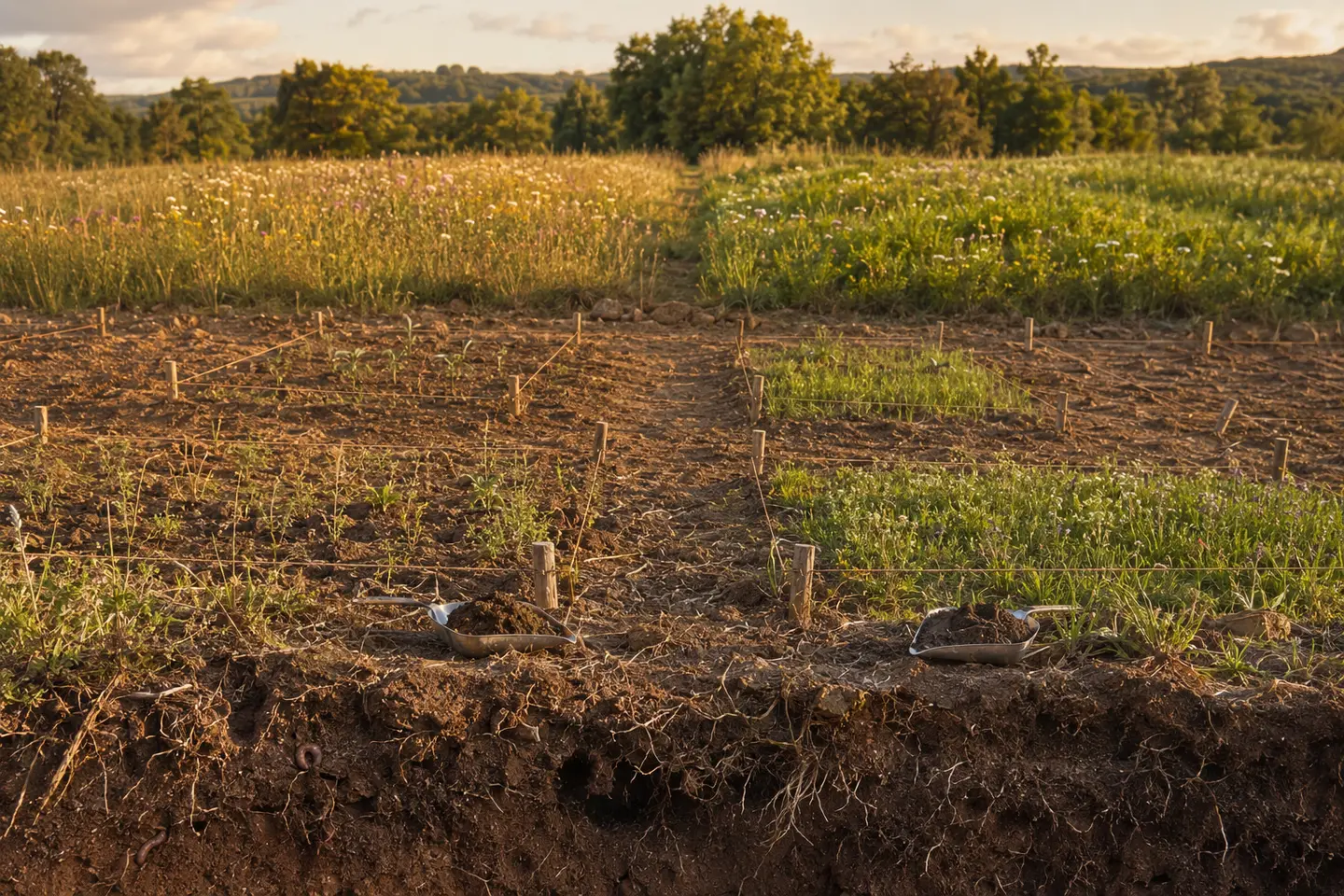
Soil was taken from the upper ten centimetres of both donor sites. On the degraded recipient site, the team first removed the upper five centimetres. It then applied 1, 3 or 5 centimetres of donor soil, equivalent to 10, 30 or 50 litres per square metre.
Plots measured two by two metres and were distributed across three blocks. A control received no inoculum after topsoil removal. The trial comprised 57 plots in total. This spatial replication makes it stronger than a simple before-and-after comparison, although it remains limited to one region.
Measuring microbes, nematodes, soil and plants together
The researchers recorded bacterial communities using 16S sequencing and fungi using the ITS region. Nematodes were examined as a higher trophic level. Soil chemistry and moisture, plant cover, species richness, and above- and below-ground biomass were also measured.
This combination is a strength. Sequencing alone could show that microbes changed, but not whether target plants benefited. Vegetation surveys alone, conversely, could not explain how soil organisms and food webs responded.
One central attribution limit remains: whole soil transfers microbes and seeds simultaneously. Soil texture, nutrients and organic matter also differ between donors. The study therefore examines the effect of a complete soil inoculum, not the isolated effect of microorganisms.
Origin and dose leave different signatures
As inoculum quantity increased, communities became more similar to the respective donor soil, and did so faster. Origin determined the direction in which microbes and plants moved; quantity determined strength and speed. There was no universal ‘healthy soil’ effect.
Fungal species richness increased with dose, while bacterial species richness declined slightly. This is not automatically negative: if a degraded site contains many disturbance-tolerant bacteria, convergence towards a reference community can also reduce diversity metrics. Composition and function are more informative than assuming that more species are always better.
Nematode effects appeared mainly in the second and third years. Higher trophic levels often respond more slowly because they first require sufficient prey, roots and stable microhabitats. This underscores why a one-year trial may underestimate soil-food-web development.
Upland Meadow shifted more strongly towards perennial target species
The less disturbed Upland Meadow inoculum produced greater perennial-plant cover and more target species. It also developed more complex statistical co-occurrence networks than Meadow Steppe inoculum. The study reports network-complexity values of 2.12 versus 1.58.
Nine of ten central organism genera increased under Upland Meadow inoculation, compared with two under Meadow Steppe inoculation. Such network metrics indicate differently organised communities, but do not directly prove every biological interaction. Co-occurrence can also arise from shared environmental requirements.
Root biomass increased with inoculation and dose. Above-ground biomass, by contrast, showed no statistically clear effect in the third year. Restoration can therefore progress below ground and in species composition before a large difference in above-ground production becomes visible.
More inoculum has a stronger effect – but costs donor area
The highest dose of 50 litres per square metre produced the strongest convergence towards the donor. Scaled to one hectare, this would require 500 cubic metres of soil – logistically demanding and potentially destructive to natural donor sites. Even 10 litres per square metre equals 100 cubic metres per hectare.
This creates a clear trade-off. Maximum short-term effect is not automatically the most responsible strategy. Small quantities, concentrated plant islands, strip application or an intermediate propagation area might initiate long-term spread with less donor material.
What remains open after three years
Three years are long enough to identify delayed nematode and plant responses, but short for the development of stable grassland soil. Whether communities persist after drought, extreme winter or the end of early maintenance remains unknown.
The trial took place in a single region. Other soils, climates and target ecosystems may show different dose–response relationships. The effects of seeds, roots, nutrients and microbes also cannot be separated in whole soil.
Nevertheless, the study delivers a clear, robust message: donor-soil origin and quantity steer different developmental pathways. Anyone planning soil inoculation must first define the reference condition being pursued.
Why this matters for RED
For RED, donor soil is not a standardised product, but an ecological relationship between source and recipient sites. Selection should consider climate, soil, vegetation, hydrology and the restoration goal. A ‘healthy’ donor is suitable only when its community fits the desired system and future conditions.
A RED project would begin with very small, replicated quantities, document donor damage and retain control plots. Alongside plants and microbes, it would measure soil animals, structure, water and spread beyond inoculation islands. Scaling would occur only after several seasons and a clear assessment of benefits, material requirements and biosafety.
Open the freely accessible original publication