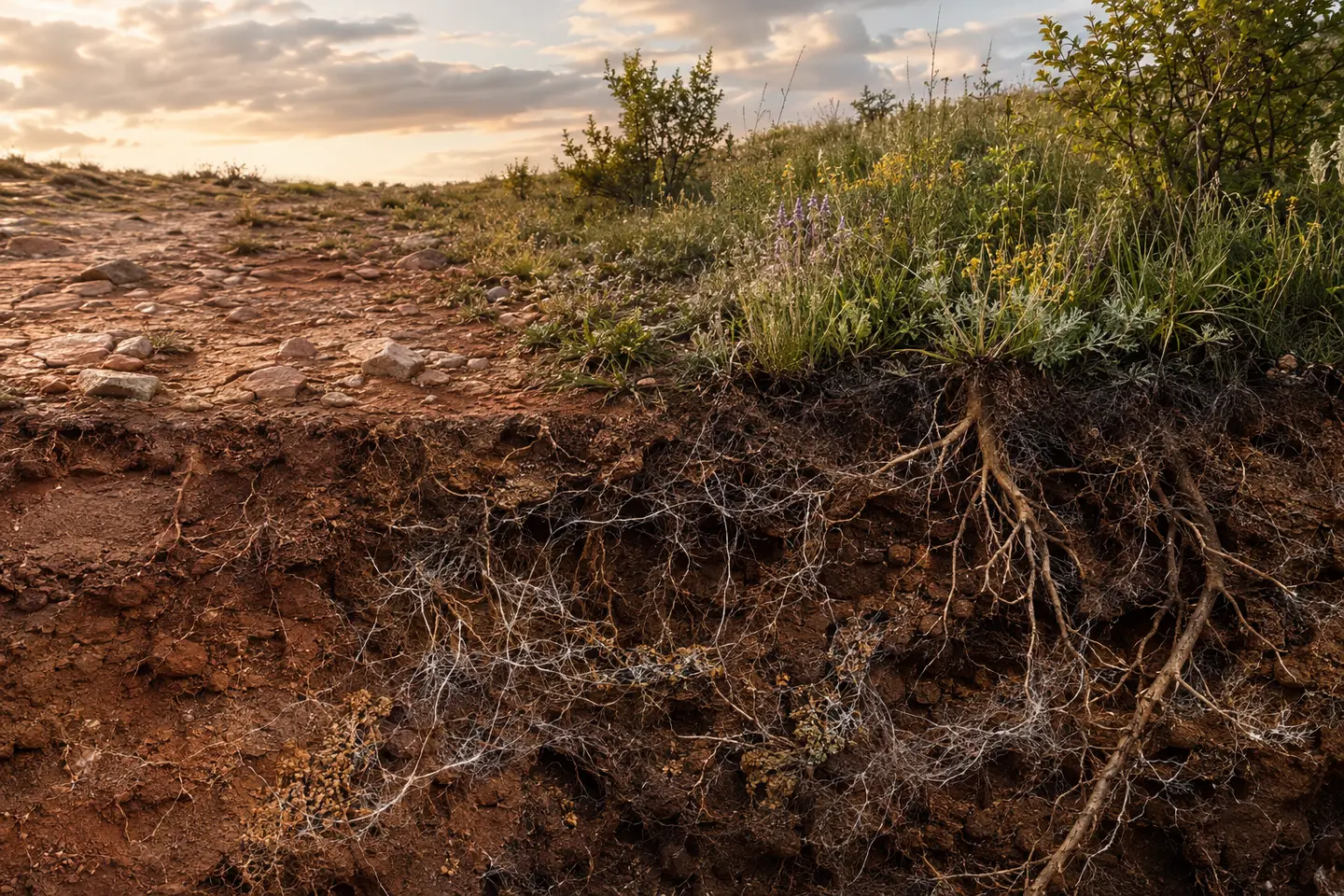
Why restoration does not end at the soil surface
Whether a degraded site becomes green again can be recognised relatively quickly. Whether a resilient ecosystem is already developing beneath the vegetation is harder to assess. The review by Zhao and colleagues therefore focuses on soil microorganisms: bacteria, fungi, archaea and their relationships with plants, nutrients and environmental stress.
The authors synthesise work from forests, grasslands, deserts, wetlands and agricultural land. Particular attention is given to heavily disturbed sites such as karst landscapes, mining areas and contaminated soils. The paper is neither a single experiment nor a meta-analysis with a shared effect size. Instead, it organises strategies and case studies across a broad research field.
Its central idea is that microorganisms are both active agents and potential indicators of restoration. They influence nutrient cycling, aggregation, plant establishment and stress tolerance. At the same time, every change in vegetation alters microbial communities through roots, litter and microclimate. Cause and response therefore continually interact.
How degradation alters microbial networks
Disturbance can reduce the biomass and diversity of particular organism groups, but above all it can simplify relationships within food and metabolic networks. Compaction, erosion, pollutants, drought or loss of plant species alter available carbon sources and create strong environmental filters. The communities that remain are those able to persist under the new conditions – not necessarily those that best support desired ecosystem functions.
The review emphasises that plant and microbial succession are coupled. Species-poor initial revegetation may protect the soil, but might provide only a narrow range of root exudates and litter. Mixtures of native species can create different rhizospheres, close seasonal gaps and thereby promote microbial diversity and network complexity.
This does not mean that maximum microbial species richness is automatically the goal. What matters is whether key functions return: nutrients should become available through biological cycles, soil structure should stabilise, plants should cope better with stress, and undesirable substances should be bound or degraded.
Three ways of working with soil microbiomes
The review first describes inoculation with individual beneficial microorganisms, including arbuscular mycorrhizal fungi, nitrogen-fixing rhizobia and plant-growth-promoting bacteria. Such approaches are relatively straightforward to produce, but often fail in the field because of competition, absent host plants or unsuitable soil conditions.
A second approach uses communities, microbial metabolites or combined materials. Consortia can cover several functions and may theoretically be more robust. More species are not automatically better, however: they may inhibit one another or require conditions absent from the target site.
The third approach deliberately combines plants and microorganisms. With heavy metals or organic contaminants, suitable plants can take up or immobilise substances, or promote microbial degradation through their rhizosphere. At nutrient-poor or erosion-prone sites, symbiotic partners can support establishment.
From mining sites to dryland biocrusts
For subsided or compacted mining sites, the review discusses mycorrhizal fungi that support nutrient uptake and root development and can thus indirectly help stabilise soil. For karst landscapes and wetlands, it mentions nitrogen-fixing bacteria such as Bradyrhizobium . In deserts, cyanobacterial communities can promote the development of biological soil crusts.
These examples demonstrate the field’s breadth but are not interchangeable. An organism functioning in saline dry soil may neither survive nor be useful in acidic forest soil. Even strains within one genus can have very different characteristics. Site-adapted selection is therefore more important than a broadly familiar species name.
There is also a temporal dimension. An inoculation may be detectable during the first months but disappear later. Conversely, small early effects can initiate plant establishment and thus long-term change even when the introduced strain is later barely detectable. Success must therefore be assessed through processes and development, not only persistent presence.
Why 16S and ITS data alone are insufficient
Modern sequencing can identify thousands of bacterial or fungal sequence variants. For bacteria, a section of the 16S rRNA gene is commonly analysed; for fungi, the ITS region. These data indicate who is probably present and how communities differ. They reveal only to a limited extent which genes are active, which substances are being transformed or whether measured DNA came from living cells.
The review therefore refers to metagenomics, metatranscriptomics, proteomics and metabolomics. Stable-isotope methods such as DNA-SIP can additionally reveal which organisms actually use a labelled substrate. These methods are more demanding, but connect communities with function more effectively.
From the laboratory to the landscape: unresolved obstacles
Many microbial approaches currently work primarily in laboratories, greenhouses or small experimental plots. In the field, inoculants encounter fluctuating moisture, heat, frost, radiation, grazing, local competitors and an established community. Dose, carrier, timing and spatial distribution influence whether they arrive at all.
Extreme weather can rapidly reverse apparently successful establishment, while long-term data remain rare. Dense vegetation after one season does not prove stable nutrient supply or a self-sustaining food web. Risks such as transferring unwanted organisms, resistance genes or pathogenic associates must also be considered with complex soil materials.
The authors therefore rightly describe large-scale microbial restoration as a developing field. Reliable establishment, functional dosage, scaling, responses to extreme events and the appropriate microbial target community for each ecosystem stage remain particularly open questions.
Why this matters for RED
The review confirms a principle of the RED Method: vegetation, soil structure and the microbiome must not be treated as separate projects. Living roots shape the microbial habitat, while microorganisms influence root nutrition and soil development. Inoculation without suitable plants and physical conditions therefore remains incomplete.
For RED, microbiotic primarily means asking better questions. Not ‘How many species are present?’, but: Which resources are transformed? Does water remain plant-available for longer? Do stable aggregates develop? Are target plants established reliably? Sequencing data can support these questions, but should always be linked with soil physics, chemistry, vegetation and repeated functional measurements.
Open the freely accessible original publication