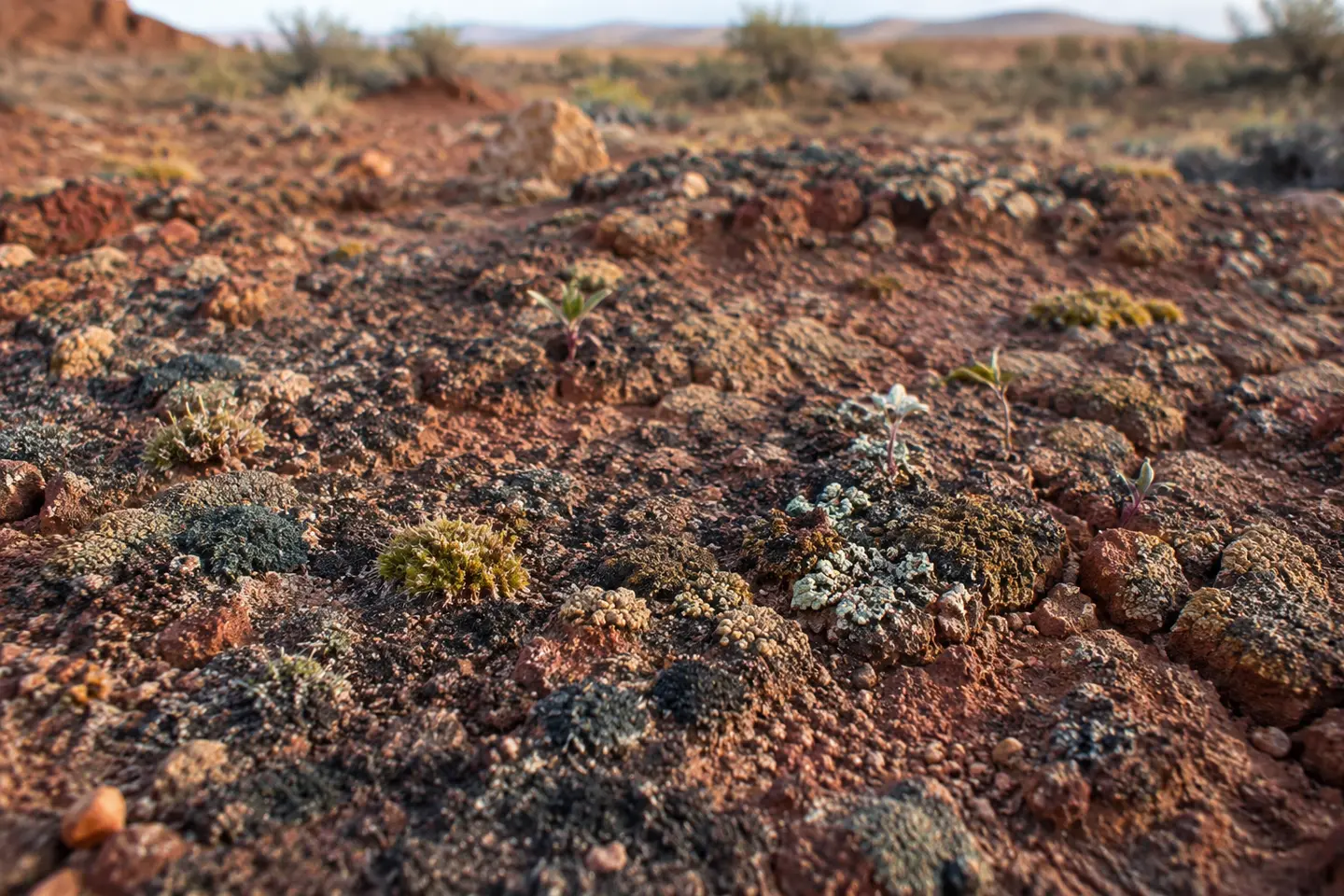
An ecosystem only a few millimetres high
On dry, apparently bare soils, a thin dark or mossy layer can form a complete ecological community. Biological soil crusts – biocrusts for short – consist, depending on the site, of cyanobacteria, green algae, fungi, lichens, mosses and other microorganisms. Their filaments, hyphae and adhesive substances bind loose soil particles and alter the immediate surface.
The review by Gufwan and colleagues describes biocrusts as a widespread component of dry landscapes. It cites possible coverage of about twelve per cent of terrestrial land and roughly one quarter to almost one third of arid and semi-arid regions. Such global estimates depend strongly on definitions and remote-sensing methods, but show that biocrusts are not a marginal phenomenon.
They do not replace higher vegetation. Instead, they occupy the spaces between plants, especially where water scarcity, wind and low nutrient availability prevent closed vegetation. This makes them a first biological interface between the atmosphere, soil and subsequent vegetation.
How microorganisms hold sand and dust together
Cyanobacteria such as Microcoleus move through the uppermost soil layer and leave behind extracellular polymers. Together with long filaments, these mucus-like substances act as a biological adhesive. Fungal hyphae bridge pores and particles; lichens and mosses later add rhizoids, dense mats and a rougher surface.
These structures increase shear strength and reduce the ease with which wind removes individual particles. During rain, they can absorb the energy of impacting droplets and slow surface runoff. Some experiments report very large reductions in erosion. Such peak values – in some cases approaching 90 per cent – are not, however, a universal performance of every crust.
Effectiveness depends on organism composition, developmental stage, soil type, slope, rainfall intensity and disturbance. A young cyanobacterial crust on loose sand behaves differently from a decades-old lichen or moss crust on finer substrate.
Water effects: greater retention, but not always greater infiltration
Biocrusts increase surface roughness and can capture dew, fog and light rainfall. Organic polymers retain water immediately around the surface, while the more stable structure can prevent surface sealing. These properties are often described as improving the water balance.
Their effect on infiltration is nevertheless ambiguous. On some fine-textured soils, a dense crust may close surface pores or divert water laterally. Elsewhere it creates stable pores and reduces rapid runoff. Drought-induced water repellency and swelling also alter the outcome.
Carbon, nitrogen and small nutrient islands
Photosynthetically active cyanobacteria, algae, lichen partners and mosses fix carbon directly from the atmosphere. Certain cyanobacteria can also fix molecular nitrogen. Dust and dissolved nutrients are retained by the rough surface; dead cells and polymers enrich organic matter within the upper millimetres.
This creates small hotspots where microorganisms and soil animals transform materials. Amounts per unit area may appear small, but are ecologically significant in nutrient-poor drylands. Biocrusts also influence gas fluxes and the chemical environment directly at the surface.
The amount of carbon stored over the long term is context-dependent. Some newly formed biomass is rapidly mineralised, while some may be protected in aggregates or on mineral surfaces. Disturbance can destroy old crusts and thereby reduce both stored carbon and future fixation capacity.
Seedbed, competition or both?
Biocrusts can capture seeds, reduce erosion around seedlings and provide moisture and nutrients. Rough moss or lichen structures create microhabitats and can moderate temperature stress at the surface. For some plant species, this improves establishment.
Other seeds penetrate a dense crust less readily, and some crusts compete for water during brief moist periods. Chemical signals and surface hardness also matter. Effects therefore depend on crust type, seed shape, plant species, rainfall timing and disturbance.
Restoration should therefore not set biocrusts and vascular plants against each other. On a mosaic-like dry site, open crust areas, plant islands and runoff pathways can perform different but interconnected functions.
Building artificial crusts: more than spraying
The review describes trials with cyanobacteria from the genera Microcoleus, Scytonema or Nostoc, sometimes as mixed cultures. Inocula are propagated on sandy or more clay-rich substrates and then sprayed, injected or distributed by hand. Covers, wind protection and adapted initial irrigation can support establishment.
Local adaptation and aftercare are decisive. UV radiation, dry periods, frost, salt, grazing and shifting sand can kill young crusts. Excess water, in turn, promotes undesirable organisms or alters the community. A successful laboratory inoculum is therefore not yet a reliable field method.
Origin is particularly sensitive. Intact natural crusts often grow very slowly and should not be removed over large areas as ‘donor material’. Cultivated, locally adapted strains and minimal, authorised sampling are more ecologically responsible.
Why this matters for RED
Biocrusts demonstrate particularly clearly that soil protection can be sustained by living relationships. A community only a few millimetres thick influences erosion, water distribution, nutrient inputs and subsequent vegetation. For RED, this expands the perspective beyond compost, roots and deeper soil horizons to the sensitive interface itself.
A possible RED approach would have to begin with protection: reduce trampling, vehicle traffic and uncontrolled runoff, map existing crusts and retain intact references. Only then would small, controlled inoculation make sense. Success should not be judged merely by visible darkening, but by surface stability, cover, species composition, water movement and effects on target plants.
Open the freely accessible original publication