The research question behind the grazing comparison
Regenerative grazing is often associated with denser vegetation, more soil life and increasing soil carbon. Such claims are plausible but difficult to test rigorously: grazing farms differ in soils, climate, history, stocking and management. The study by David C. Johnson and his team attempts to limit some of these differences through ‘across-the-fence’ comparisons.
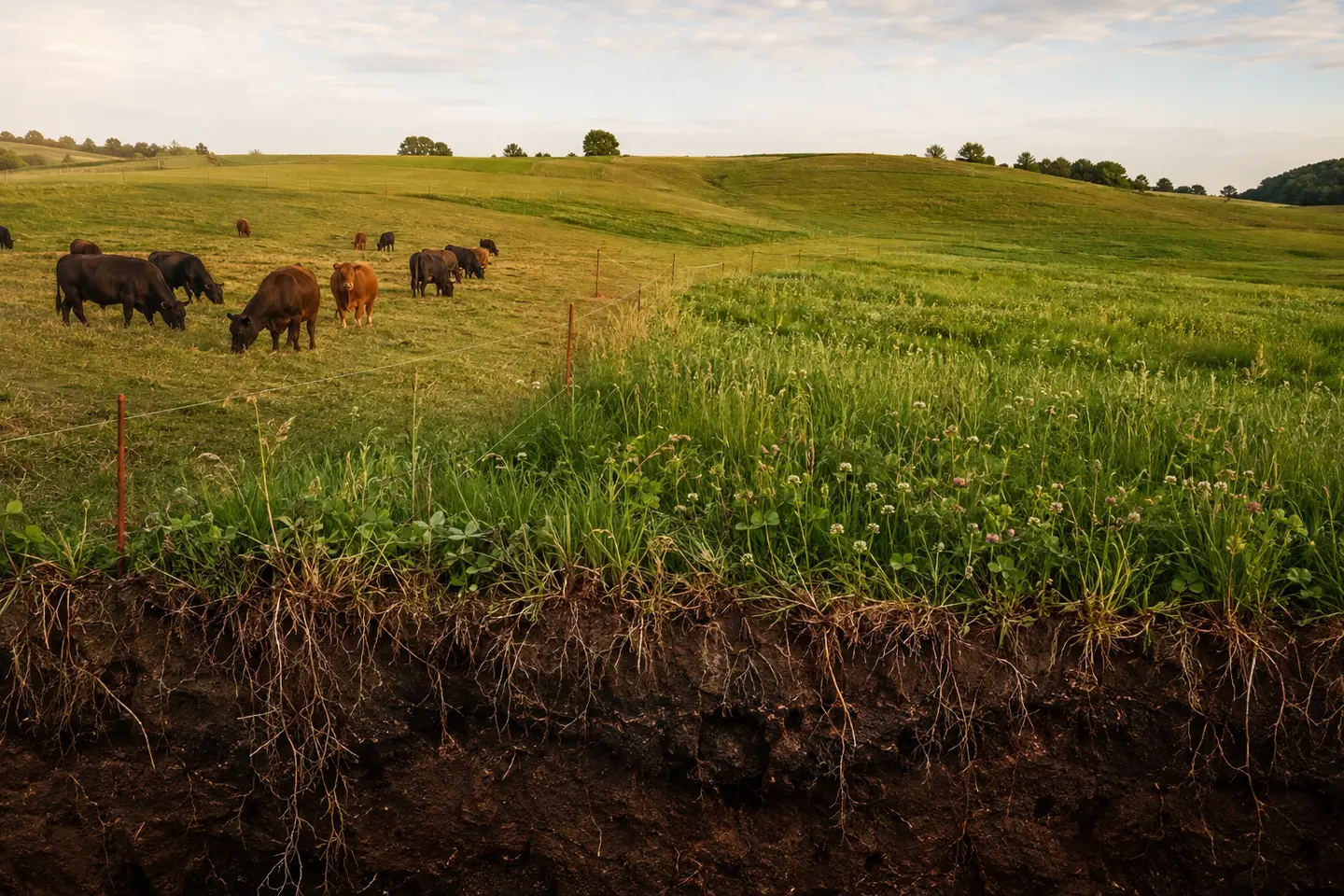
Five pairs of neighbouring cattle farms in Mississippi, Alabama, Tennessee and Kentucky were studied. In each pair, one farm had used adaptive multi-paddock grazing, or AMP, for at least ten years, while the other used more conventional continuous grazing. Because the compared areas bordered one another, soil type, topography, weather and former land use were more similar within a pair than among randomly selected farms.
In this context, AMP means that a larger herd grazes a smaller paddock briefly, followed by a longer rest period adapted to plant growth and weather. On the studied farms, pastures were typically divided into about 35 to 70 paddocks. Animals remained on a paddock for roughly one to five days; recovery usually lasted 45 to 80 days. The key is not ‘more animals’, but timing use and regeneration.
What the researchers measured
The study linked three levels: above-ground vegetation, soil organic carbon and selected characteristics of the soil food web. Twelve sampling locations were established on each farm. For carbon, 120 soil cores were taken from the upper ten centimetres and analysed by dry combustion after inorganic carbonates had been removed.
Standing plant biomass was determined in small grazing-exclusion areas. The team also recorded bacteria, fungi, protozoa and nematodes microscopically and derived several indicators. Soil respiration was measured for 24 hours after vegetation removal. It describes how much carbon dioxide is released by microbial and root-derived turnover – in this experiment, after plants were removed, primarily the microbial component.
More standing biomass and more carbon in the upper ten centimetres
Across all five farm pairs, mean standing dry matter on AMP sites was 294.14 grams per square metre. On continuously grazed comparison sites it was 201.45 grams. The difference of about 92.7 grams represents approximately 46 per cent more standing biomass under AMP management.
The team also found a difference in topsoil organic carbon: the upper ten centimetres of AMP sites contained an average of 2.838 per cent organic carbon, compared with 2.354 per cent on comparison sites – about 20.6 per cent more in relative terms. Three of the five individual farm pairs showed a statistically significant difference; two did not show a clear difference.
These figures are noteworthy, but must not be interpreted as an annual accumulation rate. A difference in carbon stock at one point in time is not a measured sequestration rate. That would require repeated measurements on the same sites over many years and a complete system balance.
Soil respiration and the food web: a nuanced picture
Measured soil respiration averaged about 19.5 per cent lower on AMP sites. A low respiration rate is not automatically ‘better’, just as a high rate is not automatically bad. Carbon dioxide release can indicate rapid organic-matter decomposition, but also active, productive soil life. What matters is the relationship between carbon input, storage and loss – and a 24-hour measurement does not provide that complete balance.
Among the microscopically recorded organism groups, bacterial biomass and protozoa differed in the pooled comparison. Differences in fungal biomass, the fungi-to-bacteria ratio and a composite food-web indicator were not statistically clear across all pairs. Within the AMP farms, researchers nevertheless found strong relationships between standing biomass and fungi, the fungi-to-bacteria ratio and protozoa.
This fits the idea that longer recovery periods enable larger, more active root systems. Roots provide exudates, dead fine roots and litter; these resources feed microorganisms and may promote aggregation and nutrient cycling. However, the correlations do not prove this mechanism in the studied dataset.
Why rest periods can be biologically decisive
After grazing, a plant must rebuild leaf area, roots and reserves. If it is grazed again before recovery is complete, its ability to direct carbon into the soil declines. An adaptive system therefore schedules the next grazing event according to growth, moisture, season and sward condition rather than a fixed calendar.
Brief grazing pulses can trample plant residues, distribute dung and urine spatially and alter competition within the vegetation. Long rest periods can then enable photosynthesis, rooting and flowering. Whether this actually creates more stable soil carbon also depends on soil type, mineralogy, precipitation, temperature and how long new organic matter is protected from decomposition.
What the study cannot answer
Five farm pairs are valuable for real-world field research but remain a small sample. Farms were not randomly assigned to management, and AMP managers may differ from their neighbours in experience, objectives, livestock handling or earlier decisions. The comparison reduces site differences but does not eliminate these influences.
Carbon was measured only to a depth of ten centimetres; shifts in deeper layers remain unknown. Bulk density, spatial heterogeneity and the choice of an appropriate reference mass are also important for comparing stocks. The study did not record methane from livestock, the complete greenhouse-gas balance, imported feed or possible displacement of emissions.
The claim that ‘AMP demonstrably sequesters a specific amount of carbon per year’ is therefore not supported by this work. What is supported is that, on the five long-term adaptively managed sites, researchers found on average more standing biomass and a higher topsoil organic-carbon concentration than on the neighbouring continuously grazed sites.
Why this matters for RED
For RED, the study’s greatest value lies less in one percentage than in its systems perspective. Plant production, root activity, soil organisms and management timing are considered together. This reflects the RED Method: rather than optimising one measure in isolation, it creates conditions in which plants and soil life can continuously exchange resources.
Baseline measurements would therefore be essential for a RED grazing project: vegetation cover and species composition, above- and below-ground biomass, infiltration, bulk density, carbon stocks at several depths and development over several years. Ungrazed or differently managed comparison plots would be equally important. Only such documentation turns a plausible management approach into a verifiable learning process.
Open the freely accessible original publication