When water leaves a landscape too quickly
The AUTarcaMatricultura permaculture system created by Barbara and Erich Graf lies on the western side of the Canary Island of La Palma. What today resembles a dense, multi-layered forest garden in places was, according to the two of them, a neglected sloping landscape for decades, with compacted soils, sparse vegetation cover and correspondingly unfavourable conditions for retaining rainwater.[P1]
Since 2007, Barbara and Erich have been developing a space for practice, learning and experience in permaculture there, covering around 40,000 m².[P1][P2] Their approach is not about optimising a single element. Water routing, soil, plants, animals, paths, use and human labour are regarded as components of an interconnected system.
Swales are among the most visible design elements in this landscape.
The English term is often translated into German as Sickermulde (‘infiltration hollow’). For the system developed at AUTarcaMatricultura, however, that term does not go far enough. The hollow is only one half of the structure.
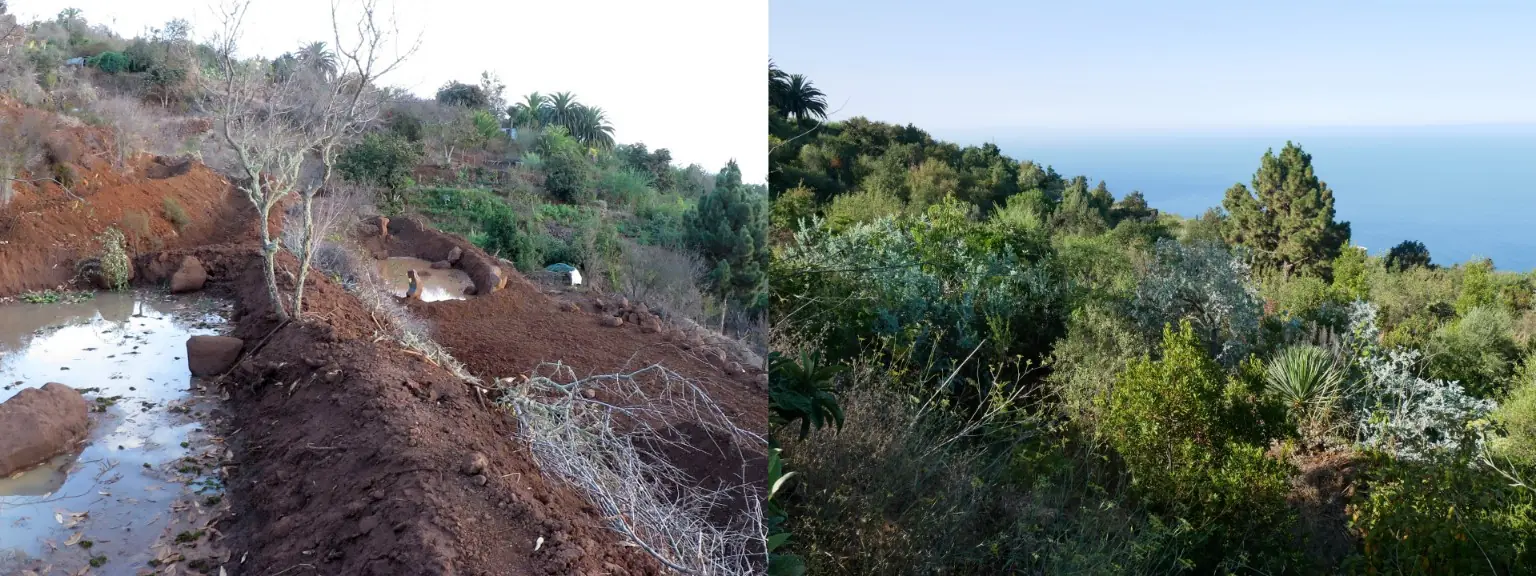
A more apt description here is a mound-and-retention-hollow system running along the contours.
A hollow alone does not make a swale system
When the swales are constructed, soil is excavated along a contour line. This creates an elongated retention hollow. The excavated soil is built up immediately alongside it to form a raised landscape feature.
At AUTarcaMatricultura, this mound is not merely an incidental consequence of the excavation, but an essential part of the system. Barbara and Erich use the entire resulting mound as a planting area.[P1] This creates additional rooting space with varying conditions of moisture, light and exposure.
Retention hollow + mound + water + soil + roots + vegetation.
Only their interaction makes it possible to understand why this initially technical landscape structure can change so fundamentally over the years.
Giving water time
On a slope, rainwater has potential energy. If rain falls at a rate faster than the soil can absorb it, or if the soil is already largely saturated, surface run-off occurs. As the flow velocity increases, fine material, organic matter and soil particles can be carried along and transported downslope.
The mound-and-retention-hollow system interrupts this direct route.
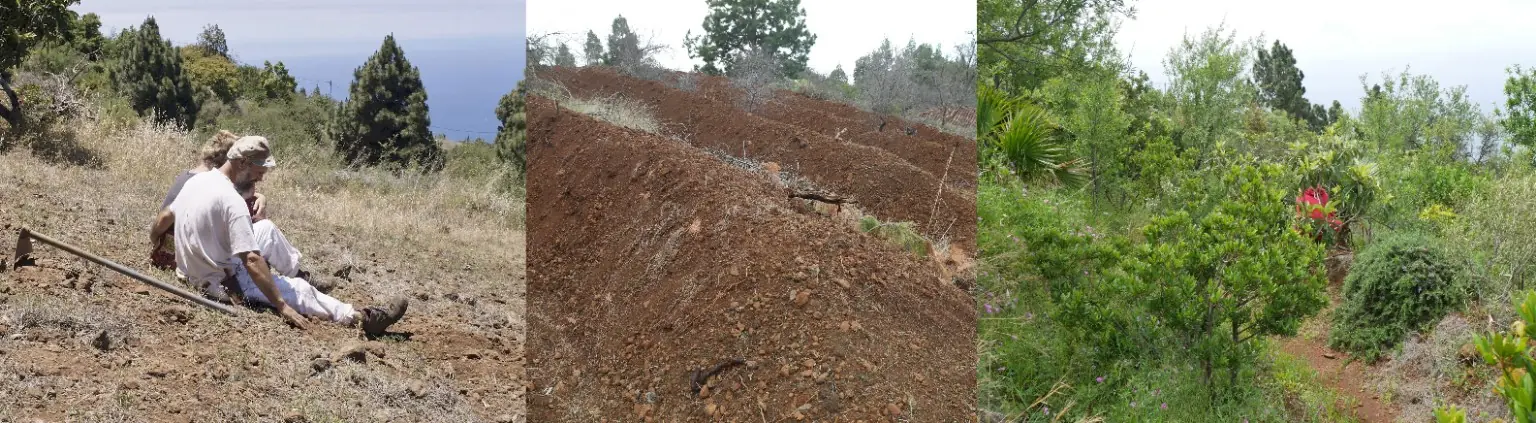
The hollows largely follow the contours. Water flowing down the slope is slowed and temporarily retained. Instead of becoming concentrated in a few drainage paths, it has more time to spread along the structure and penetrate the adjoining soil.
The crucial process at first, therefore, is not the creation of additional water, but a change in its residence time and its route through the landscape.
At AUTarcaMatricultura, Barbara and Erich observe that water from the hollows does not simply move vertically downwards; in particular, it also penetrates into and beneath the loose, increasingly well-rooted mounds. They therefore explicitly do not regard the mounds as dams.[P1]
For larger volumes of water, the project also has a separate element: more than 20 individually constructed retention ponds with normal overflows and emergency overflows. The function of these ponds must be distinguished from that of the planted mounds.[P1]
From earthworks to rooting space
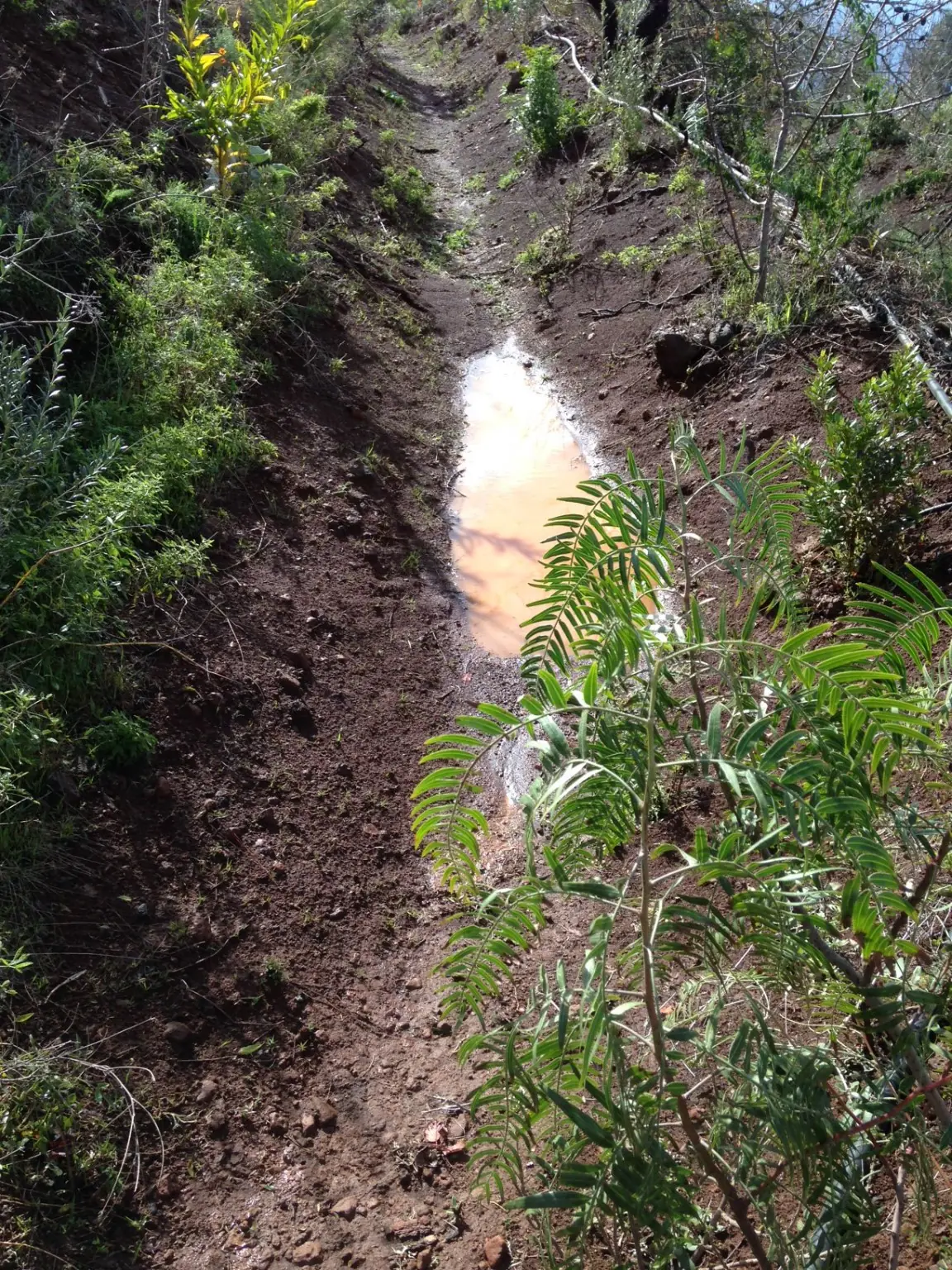
Immediately after construction, a swale initially looks like earthworks.
For Barbara and Erich, however, that is precisely where the biological development begins.
The previously compacted or heavily consolidated soil is broken up and aerated when the structures are built. The newly created mounds are planted, initially mainly with native species. Different plants then penetrate different parts of the soil profile.
Ground-cover plants protect the surface. Herbaceous plants and grasses occupy the near-surface zone. Shrubs form additional layers of vegetation, while trees increasingly extend their roots into deeper areas of the soil.
This creates something that an excavator alone could never produce: a living rooting space.
Roots change the structure of the soil. They create and use pores, supply the rhizosphere with carbon-rich compounds and interact closely with bacteria, fungi and numerous soil animals.
Dead roots, litter and other plant residues become part of this food web.
Long-term-stabilised soil organic matter is not created simply by adding organic material, but through biological, physical and chemical processes in the soil.
A living system develops the conditions required to bring carbon continuously into the soil, process it biologically and stabilise some of it over the longer term.
From water reservoir to living ‘sponge’
Barbara and Erich describe an important difference over time between a newly constructed swale and a forest-garden system that has developed over many years.
At first, the landscape structure retains water and changes its distribution.
As rooting increases, however, the soil itself changes.
Root density increases. Fungal mycelium extends through parts of the soil. Organic matter is processed. Pores form and change. Vegetation shades the surface and reduces extreme fluctuations in temperature.
As a result, the soil increasingly becomes part of a rooted storage system that absorbs water, retains it in its pore spaces, distributes it spatially and uses it biologically.
Barbara and Erich therefore describe the developing soil as an ever-growing ‘sponge’.[P1]
A swale is not interesting simply because water stands in a hollow after rainfall.
It becomes interesting where the initial change in water movement enables biological development.
Water enables plants to grow. Plants produce roots. Roots change the soil. Soil organisms gain access to new food sources. Vegetation creates shade and litter. New microhabitats emerge.
The technical structure creates the initial space – the living process continues to transform it.
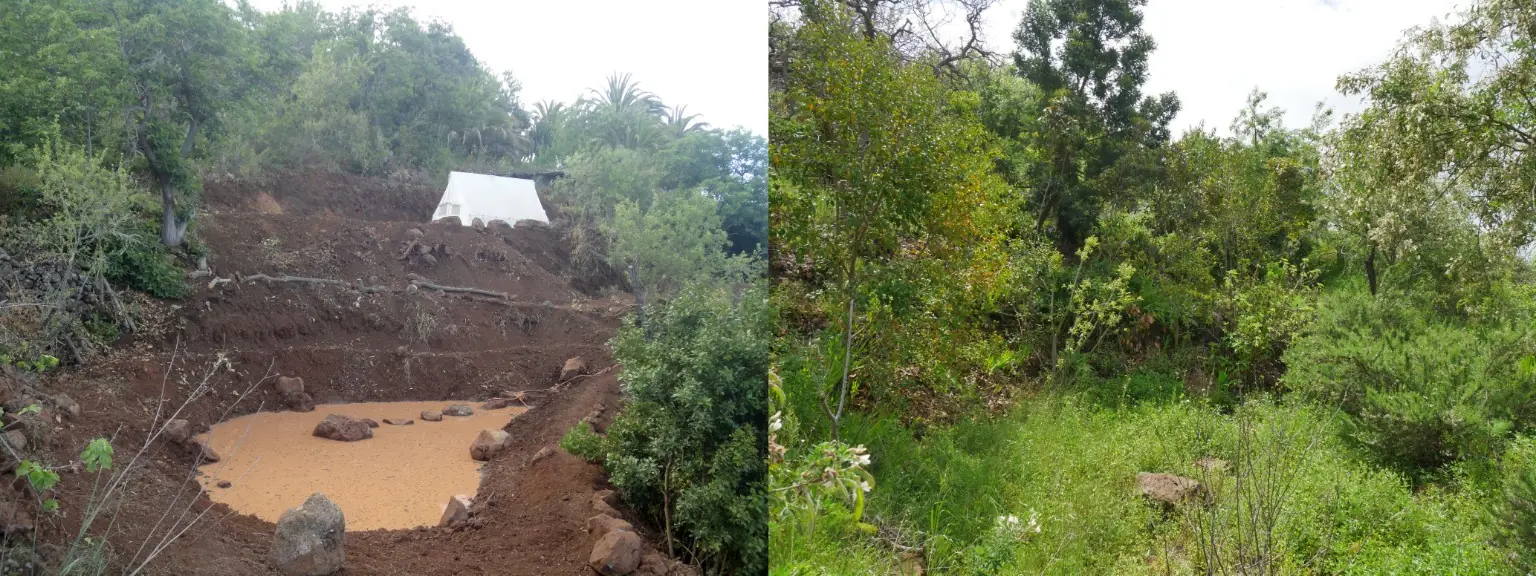
Eight times the forest-garden area with the same amount of supplementary water
One particularly remarkable long-term observation concerns the need for supplementary irrigation.
According to Barbara and Erich, AUTarcaMatricultura can now use the same amount of supplementary irrigation water to supply a forest-garden area approximately eight times the size of the original avocado-monoculture area that existed around two decades ago.[P1]
They do not attribute this development to a single effect. Alongside the retention of rainwater, they cite the increasing penetration of the soil by roots and the access that woody plants gain to deeper water reserves.
With native trees and shrubs, too, they found that after an establishment phase lasting several years, supplementary irrigation was no longer necessary in some cases.[P1]
These statements are long-term observations from this specific project. That is precisely where their value lies: they document the development observed over many years under the specific conditions at AUTarcaMatricultura.
The mound creates ecological differences
A level surface offers plants comparatively similar topographical starting conditions.
A mound beside a retention hollow changes this geometry.
Suddenly, different microsites emerge within a small area:
- a more sun-exposed upper surface
- slopes with different aspects
- a retention hollow that is temporarily wetter
- more sheltered areas
- zones with deeper and shallower rooting
As the vegetation grows taller, these differences are further amplified. Shade moves across the area. Wind is slowed. Leaves accumulate in different places. Plants alter the temperature and humidity in their immediate surroundings.
In this way, an initially simple earthen form gives rise to a multitude of small microhabitats.
In a forest garden in particular, such transition zones can be ecologically valuable because different plants, fungi, animals and microorganisms make use of different conditions.
The strength of the system therefore lies not only in water retention.
It creates space for diversity.
The retention hollow is also a path
At AUTarcaMatricultura, the hollows perform another function: in places, they are used as paths.
This naturally raises the question of whether using the retention hollows as paths leads to soil compaction. A degree of compaction of the path surface, however, is not necessarily undesirable in this system. It can help to prevent rainwater from immediately infiltrating through the surface of the hollow, allowing it to be retained for longer and then move laterally or beneath the planted mounds.[P1]
Not every square metre of a regenerative system has to maximise the same function.
The path does not have to be the area with the highest infiltration capacity if its function is to receive and channel water and make it available to the adjoining rooting spaces for longer.
At AUTarcaMatricultura, the paths also connect different elements of the water landscape. Rainfall can be channelled into swales, crater gardens, retention basins or – where the paths have been designed accordingly – cisterns.[P1]
In this way, an apparent conflict of use between ‘path’ and ‘water system’ becomes multifunctionality.
From establishment to the stewardship of a cultivated ecosystem
At AUTarcaMatricultura, regeneration does not mean that people eventually disappear from the system entirely.
Rather, Barbara and Erich describe a change in their role.
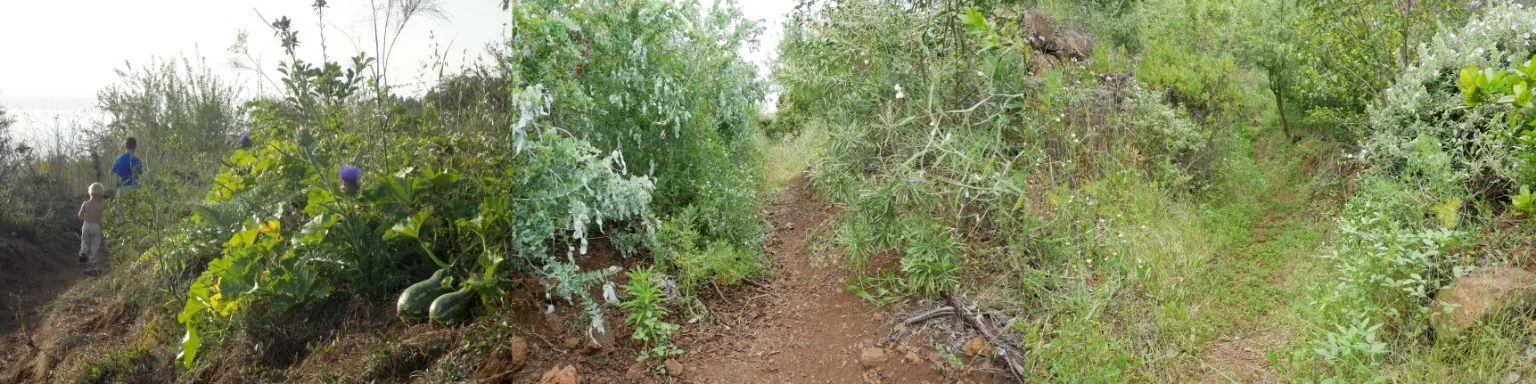
At the beginning, there is planning, earthmoving, planting and intensive care. As the system becomes more established, the vegetation grows, roots stabilise the soil and biological processes take over more and more functions.
At the same time, however, the productivity of the forest garden also increases.
Human labour therefore does not disappear – it changes.
The work of establishment becomes observation, targeted care, further planting, harvesting and use of the products of an increasingly established cultivated ecosystem.
Even after more than ten years, Barbara and Erich say that they continue to plant additional shrubs and trees in their swale areas.[P1] They therefore see succession not as a completed state, but as the ongoing densification and differentiation of the system.
A landscape that also responds differently to fire
The design of the swale landscape at AUTarcaMatricultura has another deliberately developed function: fire protection.
This does not arise simply from the presence of a retention hollow.
Barbara and Erich deliberately combined the landscape structure with vegetation presenting a low fuel load, thereby developing green protective zones within their system.
The relevance of this design became apparent in July 2023, when a major wildfire approached AUTarcaMatricultura from the direction of Puntagorda.
According to their account, the fire reached the property from three sides across neighbouring fallow terraces. Within the designed swale landscape, it was brought under control; in the retention hollows, its further spread finally came to a halt.[P1]
For Barbara and Erich, fire protection thus became a tangible experience of their system.
Do not copy the form – read the landscape
As impressive as the development on La Palma is, a mound-and-retention-hollow system is not a rigid set of construction instructions.
Its particular strength emerges where water leaves the landscape too quickly because of a slope and can usefully be slowed and distributed by altering the microtopography.
On largely level ground, water retention presents different requirements. Soil, geology, existing vegetation and the stability of the terrain must likewise be taken into account in the planning.
Barbara and Erich also adapt their swales to existing vegetation. Where trees are already present, for example, a hollow can end before the root zone and resume beyond it, rather than damaging large existing roots.[P1]
The site is not adapted to a method.
The method is developed from the site.
What the long-term development reveals
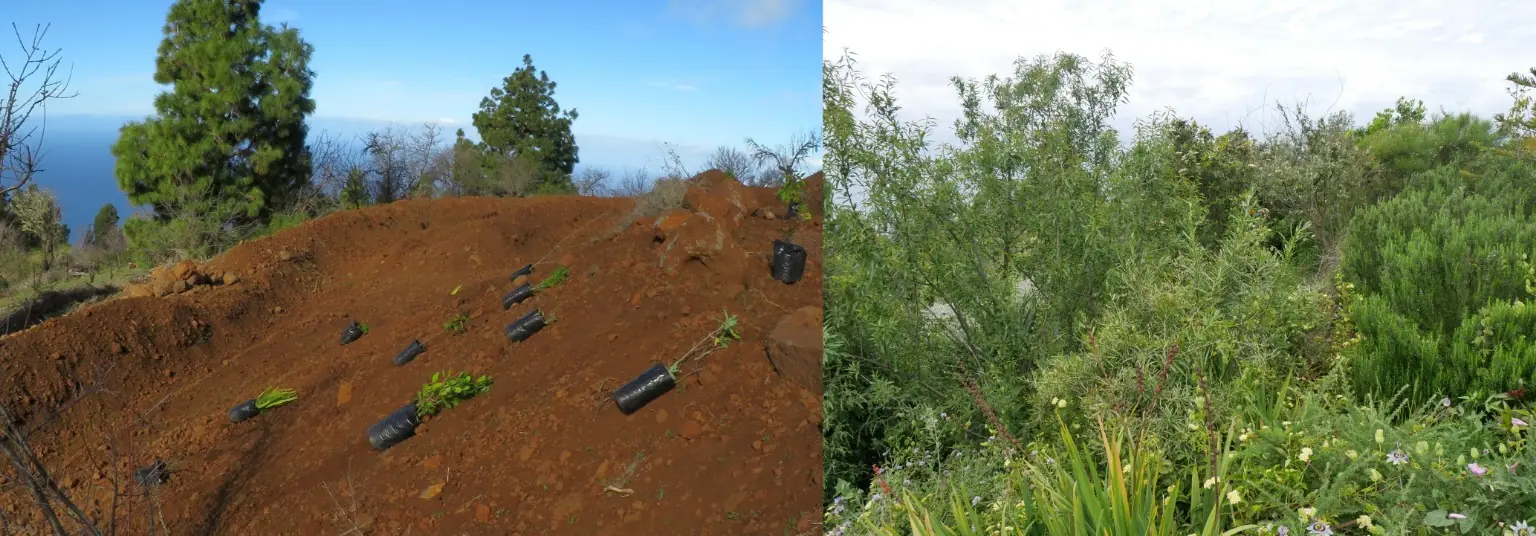
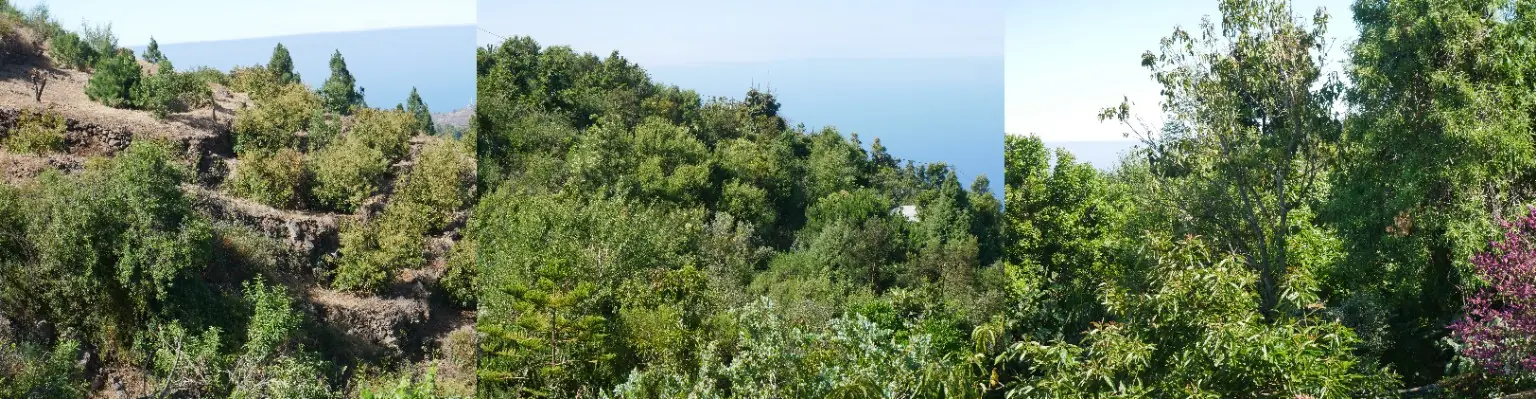
Before-and-after photographs of AUTarcaMatricultura show a remarkable transformation.
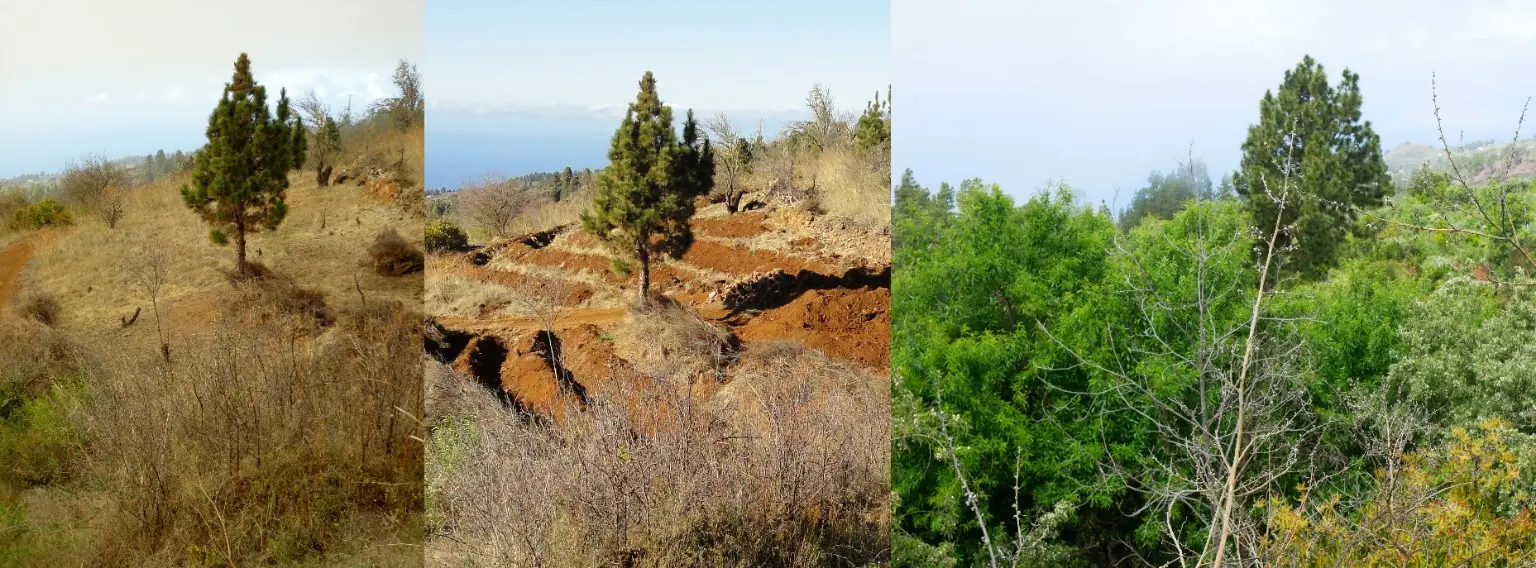
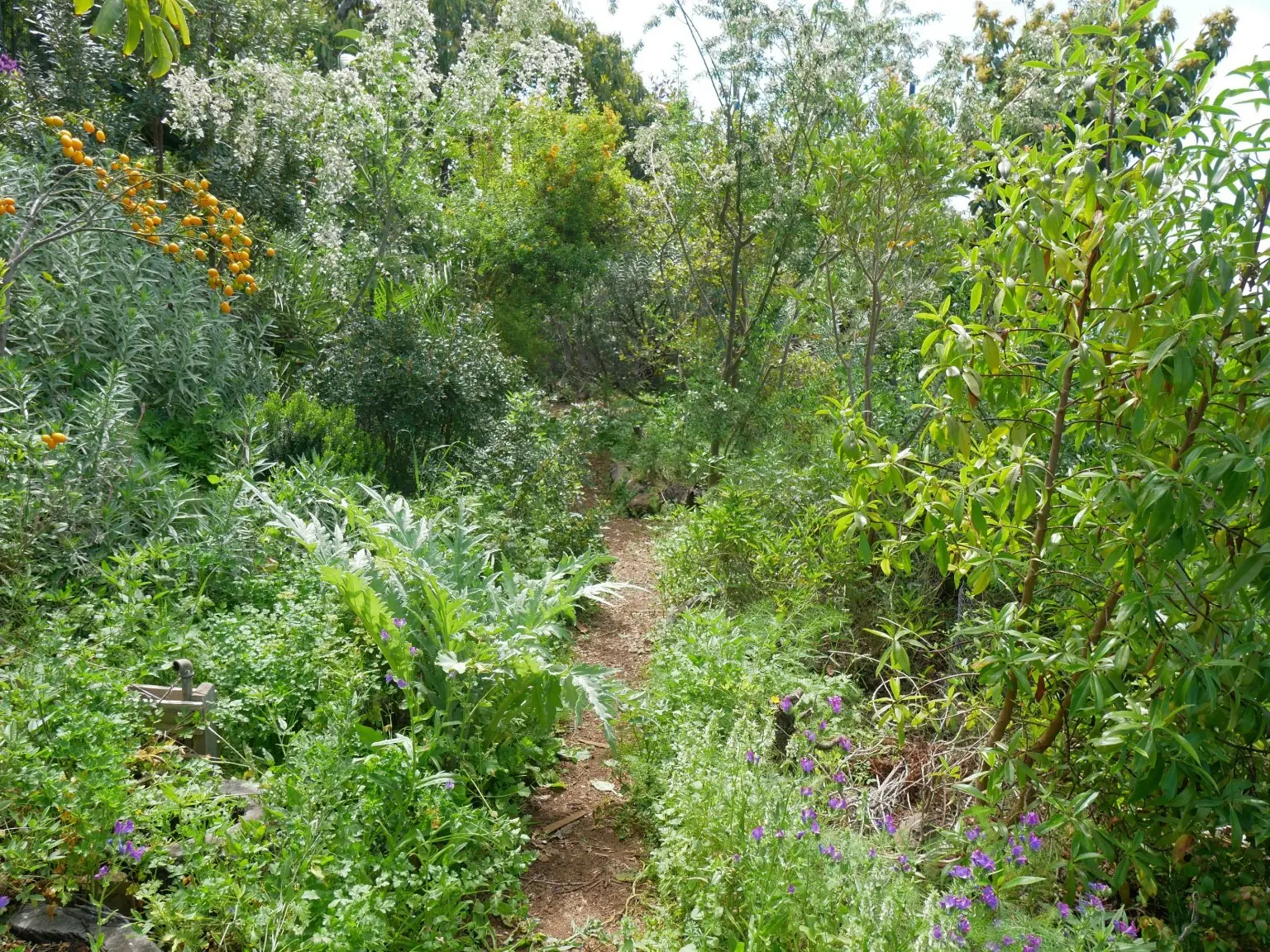
Over the years, dense, multi-layered vegetation has been able to develop on a long-neglected slope. The initially conspicuous earthworks have increasingly disappeared beneath roots, plants, litter and tree canopies.[P1][P3]
The series of images documents this development over a long period without artificially separating the processes involved.
That is precisely one of the particular strengths of this documentation.
Barbara and Erich aptly describe their own approach:
They document what they did, why they did it and what they subsequently observed over many years.[P1] The ecological context can supplement these experiences and reveal relationships without replacing observations of the specific system with general assumptions.
People provide an impetus – life multiplies it
Perhaps the development at AUTarcaMatricultura is best understood by not viewing the swale as a finished structure.
It begins with a human decision:
The route taken by the water is changed.
This initially small change creates further possibilities.
Water remains in the landscape for longer.
Roots penetrate new spaces.
Vegetation protects the soil.
Photosynthesis continuously introduces new carbon into the system.
Fungi, bacteria and soil animals process organic material.
Soil structure changes.
Shade develops.
Microclimates become differentiated.
Animals find food and habitat.
Plants occupy new niches.
Over time, what begins as earthmoving can become something that scarcely resembles a technical structure.
In a sense, the swale disappears into the system whose development it helped initiate.
From RED’s perspective, this is precisely the particular significance of Barbara and Erich Graf’s project:
It is not the retention hollow that regenerates the landscape.
Under suitable site conditions, it creates space and time for processes from which regeneration can emerge.
Nor is the mound simply piled-up earth. As it becomes increasingly rooted, it develops into a differentiated habitat that connects water, oxygen, mineral soil, plants and soil organisms.
A technical structure becomes a biological process.
Individual plants develop into a forest garden.
And the initial human intervention gives rise to countless further interactions that no person could plan individually.
People provide the initial impetus – nature responds with countless more.
About AUTarcaMatricultura
We close this article with the words of Barbara and Erich Graf. AUTarcaMatricultura never stops evolving.
More about Barbara and Erich Graf and AUTarcaMatricultura
- Official AUTarcaMatricultura website [P2]
- ‘Permaculture La Palma’ Telegram channel [P3]
- Original post about the swales (Telegram) [P4]
Film recommendation: ‘SWALES – Heilmassage für Mutter Erde’ [P4]
Editorial transparency note
This article brings together two deliberately distinct levels of knowledge:
The project-specific experiences and observations come from Barbara and Erich Graf and AUTarcaMatricultura. They are presented as such in the main text and identified with [P] = project source.
RED’s ecological context is visually set apart in the article as RED context. The associated scientific literature is identified with [S] = science / scientific source.
This keeps the experiential knowledge from the specific project and the supplementary scientific context distinguishable from one another, without setting them against each other.
The report documents a real system developed over many years. AUTarcaMatricultura’s experiences are presented in relation to the site and are not generalised as a rigid set of construction instructions.
This is because regenerative development does not begin by copying a method.
It begins by reading the site.
Sources
Project sources
[P1] Barbara Elisabeth Graf & Erich Alfried Graf · AUTarcaMatricultura: Written correspondence and editorial coordination with RED in connection with the preparation of this article, 2026.
[P2] AUTarcaMatricultura: Official project website. Information about Barbara and Erich Graf, the project’s launch in 2007, the permaculture system, forest-garden development, and educational and research work. https://www.matricultura.org/
[P3] AUTarcaMatricultura: ‘Permaculture La Palma’ Telegram channel with ongoing practical documentation, images, texts and project posts. https://t.me/PermacultureLaPalma
[P4] AUTarcaMatricultura: ‘Wie Swales eine degradierte Landschaft in einen lebendigen Waldgarten verwandeln’ and ‘SWALES – Heilmassage für Mutter Erde’, the original project post and further documentation. https://t.me/PermacultureLaPalma/273
Scientific literature for the RED context
[S1] Mondaca, P. et al. (2024): Contour furrowing reduces erosion and enhances soil moisture on semiarid hillslopes. Geoderma Regional 38, e00826.
[S2] Singh, G., Mishra, D., Singh, K. & Parmar, R. (2013): Effects of rainwater harvesting on plant growth, soil water dynamics and herbaceous biomass during rehabilitation of degraded hills in Rajasthan, India. Forest Ecology and Management 310, 612–622.
[S3] Daynes, C. N. et al. (2013): Development and stabilisation of soil structure via interactions between organic matter, arbuscular mycorrhizal fungi and plant roots. Soil Biology and Biochemistry 57, 683–694.
[S4] Sokol, N. W., Sanderman, J. & Bradford, M. A. (2019): Pathways of mineral-associated soil organic matter formation: Integrating the role of plant carbon source, chemistry, and point of entry. Global Change Biology 25, 12–24.
[S5] Lange, M. et al. (2015): Plant diversity increases soil microbial activity and soil carbon storage. Nature Communications 6, 6707.
[S6] Minasny, B. & McBratney, A. B. (2018): Limited effect of organic matter on soil available water capacity. European Journal of Soil Science 69, 39–47.
[S7] Shi, X. et al. (2021): A meta-analysis on effects of root development on soil hydraulic properties. Geoderma 403, 115363.
[S8] Bennie, J. et al. (2008): Slope, aspect and climate: Spatially explicit and implicit models of topographic microclimate in chalk grassland. Ecological Modelling 216, 47–59.
[S9] The global drivers of wildfire (2024): Overview of interactions between vegetation, fuel continuity, moisture, climate and topography in landscape fires. Frontiers in Environmental Science.